रति

Wijs gebruiker
https://www.sdentertainer.com/lifes...ing-results-for-treating-ptsd-and-depression/

Magic Mushrooms Show Promising Results for Treating PTSD and Depression
By Austin Schoonmaker | February 10, 2019
Psilocybin, the psychoactive compound found in magic mushrooms, has been shown to be highly effective in treating post-traumatic stress disorder (PTSD) and depression. Psilocybin has long been utilized by those wishing to expand their spiritual revelation through the psychedelic journey it provides, but now, scientists are beginning to explore the unique relationship it has with our brains, and how it can be used as an effective treatment for mental health patients.

According to a 2013 study conducted at the University of South Florida, psilocybin has a profound effect in stimulating what is known as neurogenesis. This phenomena results in the growth and repair of brain cells in the hippocampus, which is said the be the center of emotion in memory in our brains.

In the study, researchers strived to understand the effect psilocybin has on the brain. To do this, researchers trained lab mice to be afraid of an auditory tone, followed by an electric shock using conditioning. Over time, the mice developed a fear of the tone, as they understood that it would be followed with an electric shock. The mice’s exhibited level of fear was documented by researchers, with some mice remaining immobile for prolonged periods of time, essentially stuck in a fear response. These responses were much like how veterans with PTSD would react to certain stimulus that trigger traumatic memories.


Photo by Timothy Dykes on Unsplash
Once the groups of mice were conditioned to fear this auditory tone, researchers split the mice into three groups. One group would be injected with low doses of psilocybin, another with a high dose, while the third group was injected with an inert saline solution. The three groups of mice were then reintroduced to the auditory tone to see how well they could relinquish their fear. Of the three groups, the one which received a low-dose of psilocybin were most successful in overcoming their fears.

This study is exceptional in that it provides compelling evidence in the effectiveness of psilocybin being used for alternative forms of therapy for those who suffer from PTSD. About 11-20 out of every 100 veterans suffer from PTSD. Non-veterans in the U.S. also suffer from PTSD, often stemming from a life experience involving serious accidents, life-threatening illness, physical or sexual abuse, or natural disasters. PTSD can be easily triggered with a memory or stimulus, causing intense fear and anxiety, and can be extremely debilitating.

Already, there are several trials taking place across the country utilizing psilocybin for treating PTSD and depression. Organizations like the Multidisciplinary Association for Psychedelic Studies are championing the study and use of psychedelic compounds like psilocybin in treating psychiatric disorders. The time of prohibition for the use of psychedelic compounds for medical treatment is nearing the end, and the potential it shows for treating patients gives us a glimpse of a promising future.


____________________

https://www.businessinsider.nl/john...al-schedule-5-2018-10?international=true&r=US
A team of Johns Hopkins researchers is calling for magic mushrooms to be made legally available as medicine
Erin Brodwin 11 Oct 2018 162

Foto: Shutterstock


It’s not every day that a team of top-notch scientists calls for an illegal psychedelic drug to be made available as medicine.

But earlier this year, some of the leading researchers at Johns Hopkins University – people who’ve pioneered some of the highest-caliber studies on psychedelics’ therapeutic mental health potential – suggested that’s what should happen for a drug derived from magic mushrooms.

In a recent article published in the medical journal Neuropharmacology, four preeminent psychiatrists wrote that psilocybin, the active ingredient in magic mushrooms, should be placed in the most lenient category by the Drug Enforcement Administration and made legally available through clinicians, pending final data from several ongoing clinical trials.

In essence, they argue, the potential benefits presented by psilocybin outweigh its possible harms.

The available evidence suggests they’re correct.

Although the DEA currently considers psilocybin a Schedule I drug “with no medical use,” the past decade has seen a resurgence of research on psychedelics’ therapeutic possibilities for treating psychiatric diseases like anxiety and depression. A large recent survey also suggested that magic mushrooms could be among the safest recreational drugs.

That suggests to several experts – including the authors of the recent article – that psilocybin should be handled differently than, say, heroin or bath salts (other Schedule I drugs).

“It is the opinion of the authors of this review that the original placement of psilocybin was the result of a substantial overestimation of the risk of harm and abuse potential,” they wrote.

The authors included Johns Hopkins University School of Medicine professors of psychiatry Matthew Johnson, Roland Griffiths, and Jack Henningfield; as well as Peter Hendricks, an associate professor of psychiatry at the University of Alabama at Birmingham’s School of Public Health.

A resurgence of interest in psychedelics as medicine


Foto: sourceDaiana Lorenz/Youtube
Over the past several years, a handful of studies have suggested that psychedelic drugs like psilocybin could help treat a range of mental illnesses, including anxiety, depression, drug addiction, and PTSD.

One of those studies – a clinical trial published in the Journal of Psychopharmacology in 2016 – was written by Griffiths and Johnson, two authors of the recent piece outlining why psilocybin should be made medically available. Griffiths’ and Johnson’s seminal work concluded that in people with a terminal cancer diagnosis, a single high dose of psilocybin appeared to help pull them out of severe depression and anxiety. On a press call after the study came out, Griffiths likened the treatment to “a surgical intervention” for the mental illnesses.

Since then, research into drugs like LSD, ecstasy, ketamine, and marijuana (which many experts consider to have psychedelic properties) has abounded. Last year, a study suggested that ecstasy could help veterans cope with PTSD symptoms. Another recent paper hinted that ketamine could be used to curb severe depression. Several more recent studies of psilocybin have suggested it might help treat obsessive-compulsive disorder as well.

“At this point, the data suggest that the potential therapeutic benefits of psilocybin-assisted therapy are real, and of potential medical and public health significance,” the four authors wrote in their recent article.

The findings on psychedelics are also garnering the attention of investors and tech moguls. Just last month, German entrepreneur Christian Angermeyer launched a new biotech company called Atai with the mission of backing more psychedelic mental health research. Compass Pathways, a research startup studying and producing psilocybin for depression, recently attracted backing from tech magnate Peter Thiel.

But the legal classifications of these drugs not be keeping adequate pace with the research or the investments.

‘Replacing fear and misinformation with scientifically based facts’
Despite the ongoing research, neither the Food and Drug Administration nor the DEA has announced an intent to reschedule psilocybin or any other psychedelic. But such a move could happen. It did recently with marijuana.

In June, the FDA approved the first medicine made with a compound from cannabis. Called Epidiolex, the drug treats two rare forms of epilepsy using CBD, a marijuana compound that’s not responsible for a high. As a result of the FDA’s green light, the DEA was forced to reclassify CBD.

“We don’t have a choice on that,” DEA public affairs officer Barbara Carreno told Business Insider in June. “It absolutely has to become Schedule 2, 3, 4, or 5.”

So this September, the DEA officially shifted its stance on marijuana for the first time in 46 years by putting CBD in Schedule 5 alongside substances like cough syrup and sleep aids – all drugs that the agency considers at the lowest risk of abuse or harm.

In their article on psilocybin, the authors write that it too should be placed in Schedule 5, pending its approval as a medicine. Some experts say that could happen as soon as 2027.

“Schedule I is for substances with a high potential for abuse, lack of therapeutic approval, and that cannot be used safely in medicine,” they write. “History of use and available scientific data show that the first criterion is questionable, and the third criterion is likely not true.”

Meanwhile, the research on psilocybin is continuing to blossom. Clinical trial results from Compass are expected before 2020; researchers at the University of California, San Francisco are currently enrolling patients in a study to see whether psilocybin could assist in group therapy to improve the mental health of long-term AIDS survivors; and scientists at New York University aim to study whether psilocybin could be used to treat alcoholism.

Johnson, Griffiths, Henningfield, and Hendricks seem to believe the future of those studies – and psilocybin’s potential – is bright.

“This area of regulatory science has the potential to facilitate innovative therapeutic breakthroughs by replacing fear and misinformation with scientifically based conclusions and facts,” they wrote.


Laatst bewerkt:

रति

Wijs gebruiker
http://the-nexian.me/home/knowledge/258-mazatec-mushroom-usage-notes-on-approach-setting-species-for-curious-psilonauts

Mazatec Mushroom Usage: Notes on Approach, Setting & Species for Curious Psilonauts

By Bancopuma on Sunday, 07 April 2019, hits: 3982
There is a world beyond ours, a world that is far away, nearby and invisible. And there is where God lives, where the dead live, the spirits and the saints, a world where everything has already happened and everything is known. This world talks. It has a language of its own. I report what it says. The sacred mushroom takes me by the hand and brings me to the world where everything is known. It is they, the sacred mushrooms, that speak in a way I can understand. I ask them and they answer me. When I return from the trip that I have taken with them, I tell what they have told me and what they have shown me.” – Maria Sabina


The approach used in modern therapeutic psilocybin sessions can be summarised as “trust, surrender, let go”. Expanding on this, Dr William Richards (senior Johns Hopkins psychedelic researcher at Johns Hopkins) offers the following insight:

“The same force that takes you deep within will, of its own impetus, return you safely to the everyday world,” the manual offers at one point. Guides are instructed to remind subjects that they’ll never be left alone and not to worry about their bodies while journeying, since they will be monitored. If you feel like you’re “dying, melting, dissolving, exploding, going crazy etc.—go ahead, embrace it: Climb staircases, open doors, explore paths, fly over landscapes.” And if you confront anything frightening, “look the monster in the eye and move towards it. . . . Dig in your heels; ask, ‘What are you doing in my mind?’ Or, ‘What can I learn from you?’ Look for the darkest corner in the basement, and shine your light there.”1

This approach has been successfully applied in therapeutic psilocybin sessions at Johns Hopkins, N.Y.U. and Imperial College London and other institutions exploring the therapeutic potential of psilocybin, and appears to buffer against the adverse reactions sometimes associated with recreational use of psilocybin. The recommended setting is a comfortable room with subdued lighting, with the participant lying down wearing eyeshades on a bed or sofa, listening to playlist of carefully selected, predominantly instrumental music (avoiding human vocals) playing through headphones, ensuring comfort and encouraging the experiencer to focus inwards. The lyrical narrative of human vocals is avoided as they tend to be emotive and powerfully influence people’s experiences in certain ways. This approach has its merits and the results of some of the modern studies speak for themselves.2,3,4,5,6 However, this is a stark divergence from the approach employed by Mazatec curanderos, or shamans.

Several indigenous groups in Mexico are known to practice the ceremonial use of Psilocybe mushrooms, or what they refer to as los Santos Niños (“the Little Saints”) or nti si tho (“the little ones who spring forth”): the Nahuatls in the states of Mexico, Morelos and Puebla; the Matlazincs in the state of Mexico; the Totonacs in the state of Veracruz; and the Mazatecs, Mixes, Zapotecs and Chatins in the state of Oaxaca.7 Of these, the epicentre of usage in Mexico can be considered among the Mazatec, who are considered to possess the greatest knowledge of mushroom lore. They employ mushrooms for problem solving, physical, psychological and spiritual healing, and seeking lost or stolen objects.

Ancient tradition calls for fasting prior to ingesting mushrooms, with the exception of fruit and water if necessary. Alcohol and other drugs are avoided before and after the ceremony, or velada. One is recommend to bathe prior to the experience and wear clean white or brightly coloured clothing, while black is avoided. Powdered San Pedro (Nicotiana rustica) tobacco may be used alongside the mushrooms, applied topically to the wrists and forearms by the shaman as a tonic for the body. The tobacco is believed to have magical and remedial qualities, and is also used as an offering on the altar. Sexual abstinence is usually recommended for several days before and after a ceremony, and pork tends to be avoided during this time.

Communion with the mushroom is to be approached with humility and respect, but not fear. One should remain calm and be prepared for mental turbulence that can accompany entry into the bemushroomed realms. It is good to remain silent and speak as little as possible, at least in the beginning phase of the mushroom velada. Excessive talking can detract from the focus and energy of the experience, so conversations are reserved for later. Only the mushroom imbibers should be present, and overall, the fewer the better, as too many people may taint the atmosphere.

A single species of Psilocybe is employed in a given ceremony, and mixing of different species is avoided. Mushrooms are cleansed in copal smoke prior to ingestion, and are consumed fresh, in pairs on an empty stomach. People are encouraged to take their time to chew the mushrooms thoroughly, which allows one’s system to adjust to the experience. Unsweetened cacao is often consumed alongside the mushrooms, this being a custom practiced by the Aztec as part of their mushroom ceremonies, and according to some it greatly intensifies the visionary aspect of the mushroom. Following consumption of the mushrooms, candles are blown out, and total darkness descends. Mazatec shamans may chant and perform bodywork on participants during the velada with their hands.


Unlike the clinical therapeutic approach, the shaman ingests psilocybin alongside their patients. At the present time, patients are only permitted 1-3 psilocybin sessions in a research study context, whereas in the traditional Mazatec context, people have the option of repeated and regular sessions. The Mazatec often consume mushrooms in family groups, which is rare outside the traditional context of the velada.

The Mazatec velada setting is usually in the shaman’s home, in a room with an altar. Sessions take place during the night, often in darkness, or sometimes with candle light. This is to minimise distractions and focus the mind. A velada may begin in pitch darkness, to ensure that visions are bright and clear (an approach that well-known psilonaut Terrence McKenna also recommended), with candles lit at a later time. The presence of candles is important…beeswax candles are favoured by the Mazatec. Candle flames serve as a neutral and absorbing focal point for a tried and tested means of anchoring awareness in the present. Candle flames have been employed in this context by many cultures and traditions, such as in yogic Trataka meditation, Buddhist Kasina meditation and in Jewish ceremonies going back many centuries. The night is recognized as the time most conducive to visionary insights and deep inner work. Despite regional, cultural and linguistic differences between various indigenous groups, this setting and timing is a shared common element.

In the context of a Mazatec mushroom velada, the focal point of the setting is a traditional altar, comprising a table adorned with images of religious figures and local cultural deities, and candles and flowers. The syncretic nature of the post-Colombian Mazatec tradition made it easy for them to assimilate Christian imagery into their rituals following the Spanish invasion and the spread of Catholicism that accompanied it. Psilonauts are encouraged to focus on the candles and images, with sustained attention and avoiding “falling” into the trance, maintaining their intention on invoking the sacred. The typical Western approach, where people close their eyes and allow the music to guide them, has been described by Mazatec elder shaman Natalia Martinez as a “lazy approach”, which does not allow the full potential of the mushroom to manifest.

Of course, some Westerners may not be comfortable with pictures of religious figures, but an altar can be tailored to one’s personal resonance. For example, those with a more pantheistic perspective maybe prefer natural objects, such as shells, crystals, pine cones, flowers or feathers.


For those training with her, Natalia offers a full dinner plate of derrumbe (“landslide”) mushrooms (P. caerulescens) and encourages experiencers to maintain awareness throughout the experience. This is deemed an invaluable exercise in training one’s perception, in order that one can navigate their experience with a clear and centred mind, and allow one to work with what the mushroom presents to an undistracted mind. This is considered an essential part of the training for those who wish to provide mushroom veladas themselves. One sits erect on a small stool before the altar, maintaining awareness and open-eyed focus on the candles and images on the altar while remaining present. The altar acts as an anchor, providing a powerful means for orientating the experience and navigating challenging content when necessary. Natalia has been doing this work up to three times a week, for the past 40 years, and has amazing energy for an 87 year old woman.

Consuming mushrooms in the Mazatec setting can result in powerful experiences and openings, and this approach may yield a very distinct set of experiences from that of the Western therapeutic approach. Consumed regularly and consistently, weekly in some cases, the practice results in a set of progressive and deepening experiences, with each building upon the previous. Working with mushrooms in this way is considered by some to constitute a form of theurgy. In the US, taking mushrooms in this traditional manner means it may qualify as a sacred plant tradition, which would be protected under the Religious Freedom Act.

The Mazatec and other indigenous Psilocybe using groups tend to take the view that different species of mushroom have different qualities or their own ‘signature’. Some are revered more than others or used for specific purposes. This view is shared by ethnobotanist Kathleen Harrison, who has worked extensively with the Mazatec and various Psilocybe species, and is commonly echoed by experienced growers and psilonauts. In the context of indigenous mushroom usage, the more potent species tend to be revered more highly. There are 53 known species of Psilocybe mushrooms in Mexico, with around a third of these used ceremonially. Only a handful of species are frequently employed in veladas. Of these, the most important and commonly used species are P. caerulescens, P. mexicana, P. cubensis, P. zapotecorum and P. hoogshagenii.7 In the Aztec language Nahuatl the umbrella term teotlaquilnanácatl (“divine mushroom that describes or paints”) is applied across species.

The Mazatec hold P. caerulescens, known as the landslide or derrumbe mushroom, in particularly high regard. This species is thought to have likely been used by the Aztecs in their rituals, as documented by 16th century Spanish chronicler Bernardino de Sahagún, and referred to as teonanácatl (“flesh of the gods”). It was this species through which R. Gordon Wasson and Tim Leary had their seminal introductions to psilocybin. It is revered for its potency and its fuerza or force, the mushrooms produce a strong, physically medicinal effect, sometimes experienced as deep waves of warmth and energy in the body.

P. zapotecorum is another highly regarded and potent species, another derrumbe mushroom, known as badao zoo (“drunken mushroom”) by the Zapotec Indians. It is held on par with P. caerulescens by the Mazatec, but is a species held in particularly high esteem by the Zapotecs, from which its name is derived, and it appears to have a long history of usage among them.

P. mexicana, known as pajaritos (“little bird”) is another highly revered species used by a number of Mexican indigenous groups, it being the mushroom from which the great chemist Albert Hofmann first extracted and identified psilocybin and psilocin. It was also the most cherished species of the Mazatec shaman Maria Sabina, responsible for introducing psilocybin mushrooms to the Western world. The Mazatec say of this species ‘que suave’ (‘how smooth’). The Zapotec give this mushroom to their children as they view it as the friendliest and most forgiving. It is known by many different names among the various indigenous Mexican groups that use it, referred to as nize (“little bird”) by the Mazatec.

Another species of note is P. hoogshagenii, which is employed shamanically by the Mixe and Zapotec, and it is known by a variety of different names. In Spanish, it is referred to as los niños or los Chamaquitos (“the little boys”) as pajaritos de monte (“little birds of the woods”) by the Mazatec, and atka:t (“judge”) by the Mixe, who deem it a very wise mushroom, sought after by shamans faced with an important philosophical decision. It is interesting to note that this species (in particular P. hoogshagenii var. convexa) is highly revered by psilonauts that have grown it. It is slow to fruit, but is said to be as easy (if not easier) to cultivate than the more widely known P. cubensis. It was originally assigned the species name ‘semperviva’ which translates as ‘undying’, due to its highly resilient and tenacious nature and its ability to produce many flushes of highly potent mushrooms over many months.

P. cubensis, the San Isidro mushroom was made famous by the McKenna brothers. It has a pan-tropical distribution, growing throughout tropical and subtropical zones of the world, having spread alongside cattle farming as it grows on bovine dung. It is easily cultivated and fruits abundantly, and as a result has been cultivated worldwide. In Mexico, P. cubensis is used widely by a number of different indigenous groups, and is a dependable ally, fruiting abundantly and possessing a long growing season. It is known as di-shi-tjo-le-ra-ja (“divine mushroom of manure”) by the Mazatec. It is certainly not one of the more revered species however, and among Mexican Psilocybe-using groups is widely considered to occupy the lowest rung of the ladder of shamanic mushroom preference. Perhaps this is due to its non-native status (having being brought in with Spanish cattle), its habit of growing on dung, or its lower potency or different experiential qualities compared to other species.

San Isidro is the patron saint of the fields, farming and labour (this mushroom thriving in farmland), and some Mazatec will consume this mushroom prior to building a house or tilling a new field, or prior to embarking on some important work to give them clarity and luck. However, not all shamans will work with P. cubensis, including Maria Sabina, who never worked with it in her veladas.8 However, Mestizo charlatan shamans have been known to use P. cubensis in ceremonies as a means of generating income from tourists. In 1988, Terrence McKenna had an experience with P. cubensis that was so harrowing that he swore off heroic mushroom doses altogether.9 Psilonauts with extensive experience of the different species almost universally hold the view that those revered by shamans surpass P. cubensis in experiential qualities. This species with its universal accessibility, has been profoundly important, extending its mycelial tendrils into the brains of so many members of our species, but there is more to the Psilocybe mushroom world than it alone.

The Mazatec have over 500+ years of experience of working with mushrooms and far deeper knowledge of their phenomenology and application in healing than Westerners, who are comparative newcomers to the mushroom. There is much to be learned from the Mazatec shamans, and the loss of their knowledge would be a tragedy. Due to the advent of modern medicine however, the increasing domination of Western civilisation in Mazatecan lands, and the subsequent erosion of their cultural traditions, very few of the younger generation of Mazatec are interested in pursuing healing work using mushrooms. The traditional Mazatecan shamanic approach to working with the mushroom may soon become extinct, so we ought to prioritise the preservation and transmission of their knowledge.
 

रति

Wijs gebruiker
https://psychedelictimes.com/histor...azatec-tribe-brought-entheogens-to-the-world/

History of Psychedelics: How the Mazatec Tribe Brought Entheogens to the World

Posted by Wesley Thoricatha | Oct 28, 2015 | Articles, Psilocybin Mushrooms, Psychedelic Therapy | 0


The Mazatec of southern Mexico have used psilocybin mushrooms and salvia for spiritual purposes for generations. | Image Source: Aminus3 User pasquinolin

The Mazatec people are an indigenous tribe that hails from the mountains of Oaxaca, Mexico, best known for their syncretic form of Christianity and indigenous shamanism. In their most sacred rituals, the Mazatec use powerful visionary plants like psilocybin mushrooms and salvia divinorum to commune with spirits, divine information, heal ailments, and have a direct experience with the divine. When Westerners were allowed to participate in these rituals in the early 1950s, it opened a psychedelic Pandora’s box, introducing psilocybin and salvia to the modern world, influencing major players in the psychedelic revolution, and forever changing the landscape of modern man’s relationship to psychedelics.

Seeking the Magic Mushroom in Mexico

While history suggests that psilocybin was used by cultures dating back thousands of years, the modern world first learned about psilocybin mushrooms thanks to two Americans who traveled to Mexico in the 1950s. Gordon Wasson and Allan Richardson, a banker and a society photographer from New York, first traveled to Oaxaca, Mexico, in June of 1955 in search of a divine mushroom. There they met Maria Sabina, a Mazatec shaman, or curandera, who shared the psilocybin mushroom with them. Thanks to Sabina’s open spirit, Wasson and Richardson became some of the first Westerners to participate in the sacred Mazatec ritual called the velada.

Wasson’s account of their profound experience was published in Life magazine in 1957 in a piece titled “Seeking the Magic Mushroom,” and allegedly went on to inspire Timothy Leary and countless others to seek out the psilocybin mushroom in Mexico. The popularity of the article led to a deluge of hippies, tourists, and celebrities traveling to the Mazatec city of Huautla de Jimenez, including the likes of John Lennon, Mick Jagger, and Bob Dylan.

Maria Sabina became both a hero and an outcast for her role in sharing a guarded Mazatec tradition with outsiders. Within her own community, Sabina was seen as a traitor; vandals burned her hut down, forcing her to move to the outskirts of town. To the rest of the world, Sabina became an unlikely celebrity, and to this day she is seen as an outsider hero throughout much of Mexico as a symbol for the value of indigenous ways and psychedelic experiences.

Wasson maintained friendly relationships with Sabina despite the fallout from his article. He returned to Oaxaca in the 1960s with Albert Hofmann, the Swiss scientist famed for being the first person to synthesize and ingest LSD and the first person to isolate and synthesize psilocybin. With Maria’s help, they were allowed to take part in a ceremony with salvia divinorum. Afterwards they procured full plant specimens for botanical and chemical study, introducing yet another major psychoactive plant to the west.

Wasson also offered Sabina synthetic psilocybin pills on this visit. After journeying with them, Sabina commented that the pills had the same spirit as the mushrooms themselves, verifying the travelers’ hopes that synthesized psilocybin — which is much better suited for research and therapy — could have all the benefits and effects as the mushroom itself.

Pandora’s Box

The introduction of psilocybin and salvia to people outside the Mazatec culture was both revelatory and controversial. The Mazatec faced an unwanted tide of attention from the outside world: some of their most sacred rituals and plants were defiled by outsiders who did not see their visionary plants in the same reverential context as they did. We cannot deny the long-reaching consequences of these discoveries. But equally, we cannot discount the countless people across the world have had meaningful experiences with these plants, nor the scientific research that shows their great promise in treating end-of-life anxiety, easing obsessive compulsive disorder, ending tobacco addiction, treating depression, and reducing inmate recidivism. For better or for the worse, once the genie is out of the bottle, it can never go back. In the spirit of preserving their legacy, let us remember to appreciate the invaluable gifts that the Mazatec people have contributed to psychedelic understanding, and continue to emphasize the responsible and science-backed use of these Mazatec sacraments for healing as they were originally intended.
 
Laatst bewerkt:

रति

Wijs gebruiker
https://psychedelictimes.com/the-li...-tunnel-psychedelics-and-end-of-life-therapy/

The Light at the End of the Tunnel: Psychedelics and End of Life Therapy

Posted by Wesley Thoricatha | Sep 4, 2015 | Articles, Psilocybin Mushrooms, Psychedelic Research, Psychedelic Therapy, Psychedelics | 1


Paychedelics like LSD and psilocybin mushrooms show promise in easing end of life anxiety.

Few things are as frightening as facing one’s own mortality, and the challenges of grappling with the existential make the everyday problems of sickness and pain even more challenging. Terminally ill patients with advanced cancer or other diseases are understandably prone to depression and anxiety, which makes difficult circumstances considerably more difficult for them and their families. To ease this end of life transition, doctors have been researching the therapeutic value of psychedelics as a catalyst for emotional catharsis and acceptance that can allow patients to better come to peace with their situation. Such research gives us a chance at a major and meaningful breakthrough.

This research first started in the 60s with psychiatrist and psychedelic therapy pioneer Stanislav Grof who found very promising results before the cultural backlash against psychedelics made further study impossible. Today, this research is continuing under the guidance of leading edge Swiss and US researchers who are using psilocybin and LSD in clinical trials with terminally ill patients.

Psilocybin Aiding End of Life Therapy
Dr. Charles Grob, a researcher and psychiatrist at the UCLA Medical Center, studied the effects of psilocybin or “magic mushrooms” in end of life treatment for terminal cancer patients. Completed in 2008 and published in 2011, the study involved 12 subjects who were dying of end-stage cancer. Grob’s process involved the double-blind administration of either the psilocybin or a placebo, and gave the patients seven hours to go on an inward journey in a safe environment with regular checkups by trained staff. After the session, patients were asked to describe their experiences and their levels of anxiety were measured.

The results of Grob’s study were highly encouraging. While many of the patients underwent challenging moments during their psychedelic journey, they were cathartic and therapeutically valuable parts of the experience. Grob concluded that psilocybin was safe to administer in such an environment, and that it lead to “a significant reduction in anxiety at 1 and 3 months after treatment.” He further asserted that the results “support the need for more research in this long-neglected field.”[1. Pilot study of psilocybin treatment for anxiety in patients with advanced-stage cancer. http://www.ncbi.nlm.nih.gov/pubmed/20819978]


Psychedelics are proving emotionally valuable for patients grappling with a terminal illness.

New LSD Research
Another psychedelic being studied for end of life care is LSD. Swiss scientist Dr. Peter Gasser recently completed the first controlled trial of LSD in over 40 years, and it too produced very encouraging results. Like the psilocybin study, Dr. Gasser’s LSD study involved 12 terminally-ill patients who underwent psychedelic journeys in a controlled and safe environment. Gasser’s patients described emotional rollercoasters and mystical experiences that put their end of life transition in a new light. The results for those patients who received full doses of LSD is that “their anxiety went down and stayed down” for a year or more after treatment.[2. LSD, Reconsidered for Therapy http://www.nytimes.com/2014/03/04/health/lsd-reconsidered-for-therapy.html]

A New Hope for the Hopeless
Gasser and Grob’s research on psilocybin and LSD should be a wake up call for doctors, caregivers, and families that are dealing with terminal illness. Their studies illustrate that these psychedelics are safe to administer in a proper environment, and they offer highly valuable introspective journeys that lead to measurable positive benefits, such as anxiety reduction.

Caring for those who are facing the end of their life and easing their stress is incredibly important both for the individual and their family and friends. It is universal, and every culture has worked to ease this transition and to make it more understandable. End of life therapy is potentially entering an exciting new stage. It is wonderful news that we are once again studying and embracing psychedelics as important healing tools in these scenarios.
 

रति

Wijs gebruiker
https://psychedelictimes.com/this-t...elic-therapy-in-the-fight-against-depression/

This Too Shall Pass: Psychedelic Therapy In the Fight Against Depression

Posted by Wesley Thoricatha | Aug 20, 2015 | Articles, Psilocybin Mushrooms, Psychedelic Research, Psychedelic Therapy | 8


Psychedelics like psilocybin are making huge waves in the fight against depression.

“It was a whole personality shift for me. I wasn’t any longer attached to my performance and trying to control things. I could see that the really good things in life will happen if you just show up and share your natural enthusiasms with people. You have a feeling of attunement with other people.”
– Dr. Clark Martin reporting on his experience with psilocybin to treat depression

When depression hits, people become a shadow of their highest potential, and when depression becomes chronic, people often turn to destructive coping behaviors and prescription drugs of dubious effectiveness that have dangers all their own. Thankfully, new research is showing that psychedelic therapy using substances like LSD and psilocybin mushrooms can be enormously helpful to people with mood disorders like depression, with many patients reporting lifelong positive changes to their outlook on life.

Good News for a Seriously Bad Illness
Depression is rightfully considered a serious illness, but our traditional treatment methods with antidepressant drugs have a spotty track record in combatting it. A recent National Institute of Mental Health study illustrated that less than half of people on antidepressants claimed that their symptoms were cured, and that even among those who do respond well to medication, people often slip back into depression despite continued use of antidepressant drugs.

Keep in mind that reliance on powerful antidepressant drugs is a serious matter. The Center for Disease Control and Prevention reports that prescription drug overdoses account for more deaths than overdoses on street drugs like heroin, cocaine, and meth combined. So while the established medical system sees psychedelic treatment as somewhat radical, it’s important to understand that substances like LSD and psilocybin mushrooms are dramatically safer and often much more effective than prescription antidepressants when used properly. This is great news for those that suffer from depression and are not interested in turning to or continuing on prescription drugs.

The Power of Psychedelic Treatment
The core of depression is being out of alignment with our true nature, not following our calling, making too many compromises, and feeling trapped in our current life situation. Antidepressant drugs only temporarily numb this pain, and do nothing to address the heart of depression. Psychedelic treatment, on the other hand, has some big advantages over traditional treatment methods. The vast majority of the time, psychedelic therapy is done with just 1 or 2 doses of the substance, rather than a regiment of continued use. Psychedelic journeys are so powerful that people report lifelong positive effects from just a single experience, with lasting benefits to their mood and sense of wellbeing. Scientists are still trying to define exactly how psychedelics are able to accomplish this, but the immediacy and uniqueness of a psychedelic experience is hard to quantify. What they do know from decades of research and clinical trials is that they do work, even if we don’t know exactly how.

Where prescription antidepressants and traditional treatment methods for depression often only focus on subduing the symptoms of depression, psychedelics have a remarkable and unparalleled ability to holistically transform a person. A Johns Hopkins University study that looked into the effectiveness of psilocybin mushrooms found that even 14 months after the treatment, 94% of the 18 adults that took mushrooms in the trial claimed that their trips were among the top 5 most meaningful experiences of their lives, with 39% saying it was the single most important experience. Friends, coworkers, and family members of the subjects also reported that after treatment, they noticed they were calmer, happier, and kinder. Compare those benefits with the side effects of traditional antidepressants like Zoloft and Prozac and you can see why more research and adoption of psychedelic therapy is an exciting and hopeful prospect for depression sufferers. Psychedelic therapy for depression is faster, safer, longer lasting, and more holistically effective.
 

रति

Wijs gebruiker
https://www.lakeforest.edu/live/news/6657-the-connection-between-psilocybin-and-dreaming


The connection between psilocybin and dreaming

Sarah Pekar
Department of Biology
Lake Forest College
Lake Forest, IL 60045


Introduction

Dreaming is a universally shared concept between humans. The study of dreaming offers unique insights into human consciousness. There are five stages of sleep: stages 1-4 and rapid eye movement (REM) sleep. REM sleep is also known as active or desynchronized sleep and is when dreams typically occur. The stage of REM occurs about 90 minutes after a person has fallen asleep. Typical REM stages usually last about 10 minutes, but increase the longer a person is asleep; it is possible for REM sleep to occur for up to an hour. In previous studies, subjects that were awakened during the REM stage would report hallucinatory experiences that would follow a narrative (Nir & Tonioni, 2010; Hobson et al., 2000). Moreover, it was reported that these hallucinations involved vivid sensory and motor functions (Nir & Tonioni, 2010; Hobson et al., 2000). To be more specific, subjects would describe dreams as highly colorful. At the same time, subjects would report seeing familiar faces and objects (Nir & Tonioni, 2010; Hobson et al., 2000; Hall & Castle, 1966). Dream research offers a field of study to gain knowledge about the function of specific brain regions. With this understanding of the dream state, researchers believe there is a future in using REM sleep for the maintenance of waking consciousness.

Similar experiences have been described by patients under the influence of psilocybin. Out of the four groups of psychoactive mushrooms, the Psilocybe genus of mushrooms produces the chemical compound psilocybin. The history of psilocybin is to be used in healing rituals that date back about 3,000 years. It was also used in Western medicine until 1971 when it was listed as a Schedule I substance, with Psilocin being responsible for the psychedelic effects (Passie et al., 2002). These mushrooms can be consumed in their fresh or dried forms, as capsules, and sometimes brewed into a tea. After consuming the mushroom, users report mild euphoria and increased feeling of the five senses. Psilocybin mushrooms are not known to cause addiction (Passie et al., 2002). Once a person consumes psilocybin, it is converted into psilocin in the body. Psilocybin (O-phosphoryl-4-hydroxy-N,N-dimethyltryptamine) is converted into psilocin, a pharmacologically active compound. This conversion process takes place through a dephosphorylation reaction under strongly acidic conditions. Alkaline phosphatase is the enzyme which drives the reaction (Fig. 1) (Passie et al., 2002). Psilocin mimics the effect of serotonin. It attaches to serotonin receptors and stimulates the excessive release of the neurotransmitter (Passie et al., 2002).

Studies have shown that psilocybin has a major effect on the default mode network (DMN) (Carhart-Harris et al., 2012). The default mode network consists of the medial temporal lobe, medial prefrontal cortex (vmPFC), posterior cingulate cortex (PCC), and parts of the parietal cortex (Carhart-Harris et al., 2012). These parts of the brain working together are important for integration of sensory information. The default mode network is engaged during self-reflection, complex mental imagery, and theory of mind. When in a normal conscious state, the default mode network allows us to perceive images around us in a precise and constrained way. Normal integration of these key brain networks also gives people their sense of self (Carhart-Harris et al., 2012). Based on research, it can be seen that psilocybin produces similar physiological and neurobiological similarities in the body as dreaming during REM sleep.


Figure 1. Molecular structures of psilocybin and psilocin.

Dephosphorylation of psilocybin into psilocin


Physiological changes during REM and psilocybin

The study and report of the effects of psilocybin usage strongly focus on the neurobiological changes. There are a few reports of physiological changes in studies of psychedelic mushroom use, but the changes are distinct and very common. Fortunately, the physiological changes during REM sleep are well studied. The body experiences many physiological changes during dreams compared to the normal state. REM is categorized by eye movements during the stage. In slow-wave sleep the eyes drift apart, but in REM the eyes move in tandem, similar to their behavior in the awake state. Moreover, it is hypothesized that in order to conserve energy, a person’s body temperature drops to its lowest point of the night during REM, which can be as low as 96.5 °F (Brands et al., 199:sunglasses:. Subjects using psilocybin have been found to have the opposite effect. When using psilocybin, it is reported that the person will have an increased body temperature (Brands et al., 199:sunglasses:. Before REM sleep, blood pressure and heart rate decrease in order to adapt to reduced metabolic needs (Penzel et al., 2003; Purves et al., 2001). However, when the body reaches REM, these activities increase to levels that are almost as high as the awake state. Although the reason is not well understood, subjects using psilocybin have been found to have increased heart rate and blood pressure, just like during REM sleep (Brands et al., 199:sunglasses:. In REM there is also a paralysis of large muscles and twitching of the fingers and toes during REM (Purves et al., 2001). Similarly, research shows that the use of psilocybin causes muscle relaxation, weakness, and twitching (Brands et al., 199:sunglasses:.

Neurobiological changes during REM

Recent studies have revealed the potential use of psilocybin mushrooms in both research and therapies. The research done under Dr. Carhart-Harris has revealed astounding results on the effects of psychedelics on the brain. In Harris’ study done in 2012, researchers used psilocybin to study the neural correlates of the brain on the psychedelic. Fifteen subjects were intravenously given either a placebo (10 mL of saline) or psilocybin (2 mg in 10 mL of saline). The infusion was done over a sixty second time period and the subjects would feel the results almost immediately. Before the infusion, the subjects were placed in an MRI. The study was done using an arterial spin labeling perfusion, and was done again using a blood- oxygen level dependent fMRI. In both cases, the subject was asked to rate the intensity of the image of a fixation cross at specific


Figure 2. Cerebral blood flow in brain regions.

Cerebral blood flow in the thalamus, anterior cingulate, and posterior cingulate cortex before and after psilocybin infusion, compared to placebo infusion.

times; once immediately after the start of the MRI, prior to the infusion, six minutes after the infusion, and finally twelve minutes after the infusion. The results were not what they expected. Studies researching the neuronal functionality agree that activation of the amygdala is higher during dreaming (Braun et al., 1997; Maquet et al., 1996; Nofzinger et al., 1997). In addition, during the dream state there is a partial activation of limbic regions of the forebrain, which are involved in memory and emotion. In research done by John Hobson (2009), there was a focus on the activation of the default mode network, compared to the brain regions previously discussed. Multiple studies done using PET by Hobson have shown a decrease in activity in the lateral prefrontal cortex and posterior cingulate cortex during REM The study revealed that there was a significant decrease in cerebral blood flow in the regions that made up the default mode network, as previously discussed. Both MRI’s showed decreases in blood flow in the thalamus, prefrontal cortex, posterior cingulate cortex, and anterior cingulate cortex (Fig. 2). The study also found that there was increased brain activity in the parts of the brain that play a role in visual imagery (Carhart-Harris et al., 2012). Based on these results, researchers were able to make conclusions about the neural correlates of the brain. Moreover, they were able to understand why the default mode network had decreased cerebral flow and other parts of the brain involved in the senses had increased blood flow. Dr. Carhart-Harris describes the DMN as a central hub for the rest of the brain. When there is normal activity to the DMN and normal integration of the key brain networks, the senses are constrained and precise. Therefore, all humans are able to see the world in a similar way if these brain networks are functioning correctly. However, when there is decreased integration of the key brain networks, like after consuming psilocybin, cognition and the senses are unconstrained, giving a sense of euphoria. Studies have suggested that consuming psilocybin places a person in a “waking dream state”.

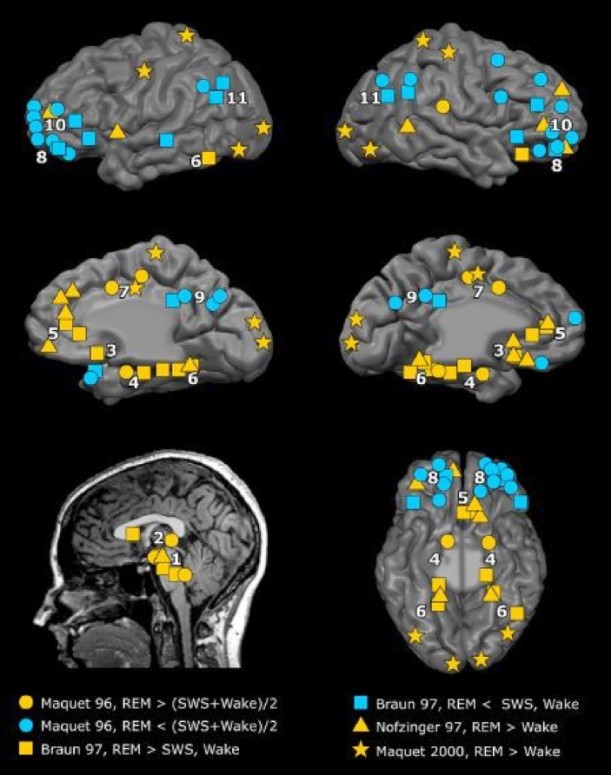
Similar fMRI and PET studies have been done to map the brain and its functionality during dreaming. PET technique in 1996 showed a decrease in neuronal activity at the orbitofrontal cortex and posterior cingulate cortex and an increase of activity at the thalamus, anterior cingulate cortex, and amygdala during REM sleep (Braun et al., 1997; Maquet et al., 1996; Nofzinger et al., 1997). In a study done in 1997, it was found that there was a decrease of neuronal activity at the posterior cingulate cortex and increase of activity at the amygdala, thalamus, and medial prefrontal cortex during REM sleep (Braun et al., 1997; Nofzinger et al., 1997). Based on PET results, there was an increase of activity at the anterior cingulate cortex (Fig. 3) (Nir & Tonioni, 2010).


Figure 3. Meta-analysis of PET results.

Circles, squares, triangles, and stars signify significant changes in activity as reported by Maquet (1996), Braun, Nofzinger, and Maquet (2000), respectively. Yellow denotes an increase in neuronal activity, while blue denotes a decrease in neuronal activity in the region tagged.

Studies researching the neuronal functionality agree that activation of the amygdala is higher during dreaming (Braun et al., 1997; Maquet et al., 1996; Nofzinger et al., 1997). In addition, during the dream state there is a partial activation of limbic regions of the forebrain, which are involved in memory and emotion. In research done by John Hobson (2009), there was a focus on the activation of the default mode network, compared to the brain regions previously discussed. Multiple studies done using PET by Hobson have shown a decrease in activity in the lateral prefrontal cortex and posterior cingulate cortex during REM sleep, compared to the waking state and lucid dreaming (Fig. 4) (Hobson et al., 2009). The similarities and differences of these findings, compared to psilocybin, could lead to a deeper understanding of the functionality of certain brain regions.


Figure 4. PET results of brain activation.

A. Red signifies the deactivation in brain regions. Results showed a deactivation of the lateral prefrontal cortex and posterior cingulate cortex. All other brain regions studied showed an increase of activity, denoted by the color blue.

The studies discussed reveal strong similarities, as well as some differences, between the neuronal activity during REM sleep and psilocybin use. While psilocybin research reveals a decrease in activity in the thalamus, prefrontal cortex, posterior cingulate cortex, and anterior cingulate cortex, REM studies find deactivation only at the lateral prefrontal cortex and posterior cingulate cortex during dreaming. Conversely to the psilocybin research, REM studies show an activation of the anterior cingulate cortex and amygdala. These conclusions place a focus on the function of the posterior cingulate cortex and prefrontal cortex. Research shows that tasks such as memory and learning depend on the function of the prefrontal cortex (Puig & Gulledge, 2011). The function of the posterior cingulate cortex is not understood as well as other brain region, however, it is hypothesized that its deactivation during cognitively demanding tasks could mean that its function is to control the activity of brain regions involved in the senses (Leech & Sharp, 2014; Sing & Fawcett, 200:sunglasses:.

Conclusion

Scientists believe that psilocybin mushrooms place people into a ‘waking’ dream state. The reasons for this are that these mushrooms create brain states that usually only occur when a person is sleeping. Research done by Dr. Carhart-Harris concludes that there is increased brain function in areas of the brain that are associated with emotion, due to the lack of cerebral blood flow to the default mode network. These same areas that are associated with emotion and memory also have increased functionality during dreaming.

Analyzing the biological similarities and differences of psilocybin use and dreaming not only allows researchers to gain an understanding of the functionality of the brain, but also opens up the doors for using psilocybin mushrooms as a therapy for diseases like depression and anxiety. It may seem counterintuitive to prescribe a drug that would increase functionality in the part of the brain that controls emotions, but the neural connectivity studied by Dr. Carhart-Harris speaks to its possible efficacy. Studies have shown that depression can be linked to REM sleep dysregulation (Palagini et al., 2013). A possible area of study for the future would be to

see if placing people into a waking dream state using psilocybin could treat depression and anxiety.

Another possible area to study would be the default modes network role in depression and anxiety. Carhart-Harris believes that people with these diseases suffer from a strict theory of mind and sense of self due to increased areas of the DMN, such as the posterior cingulate cortex and prefrontal cortex. If psilocybin could reduce the functionality of these brain regions, it is possible that people with depression and anxiety would see the world in a different way.

This research on psychedelic mushrooms gives the possibility for future use of psychedelics in the scientific and medical community. Its current legal status, however, makes future studies on psychedelics difficult. Yet, researchers remain hopeful that these studies will shift community attitudes towards psychedelics.
 

रति

Wijs gebruiker
https://www.evolveandascend.com/2017/04/25/magic-mushrooms-activate-the-waking-dream-state/

Magic Mushrooms Activate the ‘Waking Dream’ State

Psychedelic mushrooms also known as magic mushrooms are gateways to a greater level of understanding about the self, humanity, and the world around us. Due to their ability to activate a waking dream, it gives us insight that goes far and beyond our usual scope of awareness.

So, the question becomes how is this magical phenomena possible?


A magic mushroom experience is sometimes referred to as surreal, leading to life-changing messages from their subconscious mind. Shroomers claim to have intense, animated and maybe even somewhat lucid dreams for several days following their trip. If you suffer from a lack of dreams due to consuming a large amount of marijuana, then mushrooms ability to enhance the dream state may be the answer to this dilemma.

What Is the Difference Between Dreaming and Tripping?
Mushroom trips can be comparable to what is experienced in the state of consciousness right before slipping into sleep. The brain begins to unwind becoming less active thus allowing visions and imagery to occur. The more mushrooms you consume, the stronger the hallucinations are, and they can manifest so well that you feel everything you are seeing is literally right in front of you. Talk about surreal!

This trip can take you to a completely different world where you feel you are no longer in touch with this reality. Like other psychedelic substances, large doses can lead to alien contact and otherworldly communication. You may find yourself traveling beyond this reality into other realms. These journeys feel so real and intense, almost like lucid dreaming.

What is Lucid Dreaming?
When you reach a dream state where you have full consciousness and know that you are dreaming, with the ability to control what happens in the dream, you are lucid dreaming. This happens during what is called REM sleep, which is a very deep dream state. Having a lucid experience requires the dreamer to be aware that something is different about the reality they are in and from there they can either realize it’s a dream then enter a lucid state or wake up.

How Lucid Dreaming and Mushrooms Trips are Similar

The initial correlation between a dreamer and shroomer is their acceptance of the overall experience as if this is nothing out of the ordinary. Lucid dreaming gives the power of being in full control of everything, including the unthinkable. Lucid dreams also have the ability to cause out-of-body-experiences. Lucid dreams can be thought of as “dreaming awake,” while psychedelic mushrooms are more of a “waking dream” experience where there is full access to the subconscious while the shroomer is still fully awake taking in information.

Now let’s take a look at what happens during the dream state.

Is It a DMT Trip?
Dreams are a result of the pineal glands production of DMT which has long been connected to astral travel, psychic visions, and dreams.

Both psilocin and the DMT molecule have quite the same structure. What separates the two is the fact that you must consume psilocin orally to stimulate the effects. Magic mushroom is one of the few forms of DMT that does not require a monoamine oxidase inhibitor to be activated.

One can easily gather from this information that considering DMT is a dream molecule, psilocybin will produce similar effects.


The Scientific Perspective

Scientific studies provide a more in-depth understanding of how psilocybin influences users. A study was conducted at Imperial College London where 15 people received a dose of pure psilocybin and were evaluated in an MRI machine.

According to this study, psilocin reduced the parts of the brain linked with higher thinking and connection to self. The user’s ability to be fully open to their experience during a mushroom high is a result of this leading to them being out of their ego.


Another thing researchers found is the parts of the brain responsible for basic emotions such as happiness, fear, and anger are more noticeable. This process of the brain unwinding from its higher cognitive processes to a more basic state is not much different from what happens with dreamers during these studies.

This is where we can bring everything together and realize that magic mushrooms activate a “waking dream” state, in which the user can explore the subconscious and receive information from a lucid state.

It wouldn’t be too farfetched to consider psilocybin as a way to normalize the body’s dreaming and sleep processes.

Our History with Magic Mushrooms
Psilocin mushrooms have been around since very ancient times. There was no shortage of shroom supply during ancient times when primate humans coming out of the jungles encountered magic mushrooms. According to Terence Mckenna, psilocybin mushrooms are directly connected to human metabolism and could have been the motivation for the mental development at that time.

The Aztec people considering shrooms to be the flesh of the Gods. Once Christians began to influence the use of magic mushrooms, governing bodies across the globe inhibited the free use or consumption of it. Many who understand the benefits of psilocin would consider this a step backward in evolution.

Thanks to the consistent push to study medicines such as this, we are rediscovering profound information about the power of psilocybin mushrooms.

This medicine can remove all limits within the mind and break down the ego, therefore opening you up to worlds beyond this dimension. It is a gateway to understanding the inner workings of our own minds, everything about who we are. Due to recent studies on mushrooms, modern humans are able to learn about the different aspects of our consciousness and how this pertains to the direction in which humanity could evolve. Considering all of the current research, it is clear to see that it inspires waking dreams and can take our human experience to greater heights. This gives a whole new meaning to the phrase dream big!
 
Laatst bewerkt:

रति

Wijs gebruiker
https://www.tandfonline.com/doi/full/10.1080/02791072.2019.1580804

Sub-Acute Effects of Psilocybin on Empathy, Creative Thinking, and Subjective Well-Being
Natasha L. Mason , M.Sc., Ph.D. , Elisabeth Mischler , Ph.D., Malin V. Uthaug , M.Sc., Ph.D. & Kim P. C. Kuypers , Ph.D.
Pages 123-134 | Received 23 Oct 2018, Accepted 18 Jan 2019, Published online: 26 Feb 2019

ABSTRACT
Creative thinking and empathy are crucial for everyday interactions and subjective well-being. This is emphasized by studies showing a reduction in these skills in populations where social interaction and subjective well-being are significantly compromised (e.g., depression). Anecdotal reports and recent studies suggest that a single administration of psilocybin can enhance such processes and could therefore be a potential treatment. However, it has yet to be assessed whether effects outlast acute intoxication. The present study aimed to assess the sub-acute effects of psilocybin on creative thinking, empathy, and well-being. Participants attending a psilocybin retreat completed tests of creative (convergent and divergent) thinking and empathy, and the satisfaction with life scale on three occasions: before ingesting psilocybin (N = 55), the morning after (N = 50), and seven days after (N = 22). Results indicated that psilocybin enhanced divergent thinking and emotional empathy the morning after use. Enhancements in convergent thinking, valence-specific emotional empathy, and well-being persisted seven days after use. Sub-acute changes in empathy correlated with changes in well-being. The study demonstrates that a single administration of psilocybin in a social setting may be associated with sub-acute enhancement of creative thinking, empathy, and subjective well-being. Future research should test whether these effects contribute to the therapeutic effects in clinical populations.

KEYWORDS: Convergent thinking, creativity, divergent thinking, empathy, life satisfaction, psilocybin
Introduction
Creativity and empathy are crucial for everyday interactions and cooperation, allowing us to adapt to an ever-changing environment, and motivating our prosocial behaviors (Decety et al. 2016 Decety, J., I. B. A. Bartal, F. Uzefovsky, and A. Knafo-Noam. 2016. Empathy as a driver of prosocial behaviour: Highly conserved neurobehavioural mechanisms across species. Philosophical Transactions of the Royal Society B: Biological Sciences 371 (1686):20150077. doi:10.1098/rstb.2015.0077.[Crossref], [PubMed], [Web of Science ®] , [Google Scholar]). Interestingly, they have been found to be positively related (Carlozzi et al. 1995 Carlozzi, A. F., K. S. Bull, G. T. Eells, and J. D. Hurlburt. 1995. Empathy as related to creativity, dogmatism, and expressiveness. The Journal of Psychology 129 (4):365–73. doi:10.1080/00223980.1995.9914974.[Taylor & Francis Online], [Web of Science ®] , [Google Scholar]), and it has been suggested that creative, flexible thinking is a prerequisite for empathy (Eslinger 1998 Eslinger, P. J. 1998. Neurological and neuropsychological bases of empathy. European Neurology 39 (4):193–99. doi:10.1159/000007933.[Crossref], [PubMed], [Web of Science ®] , [Google Scholar]). Previous research demonstrates a reduction in these skills in populations where social interactions and subjective well-being are compromised (Beck 1967 Beck, A. T. 1967. Depression: Clinical, experimental, and theoretical aspects. Philadelphia: University of Pennsylvania Press. [Google Scholar]; Neumann et al. 2011 Neumann, M., F. Edelhäuser, D. Tauschel, M. R. Fischer, M. Wirtz, C. Woopen, A. Haramati, and C. Scheffer. 2011. Empathy decline and its reasons: A systematic review of studies with medical students and residents. Academic Medicine 86 (:sunglasses::996–1009. doi:10.1097/ACM.0b013e318221e615.[Crossref], [PubMed], [Web of Science ®] , [Google Scholar]).

Creativity is a multicomponent construct, consisting of convergent (CT) and divergent thinking (DT) (Guilford 1967 Guilford, J. P. 1967. The nature of human intelligence. New York, NY, US: McGraw-Hill. [Google Scholar]). CT is considered a process of generating a single optimal solution to a particular problem, emphasizing speed, accuracy, and logic. Conversely, DT is a process used to generate many new ideas, in a context where more than one solution is correct. An example of the latter is a brainstorming session, where generating many innovative ideas or solutions on a particular issue is the ultimate goal (Colzato, Szapora, and Hommel 2012 Colzato, L., A. Szapora, and B. Hommel. 2012. Meditate to create: The impact of focused-attention and open-monitoring training on convergent and divergent thinking. Frontiers in Psychology 3 (116). doi: 10.3389/fpsyg.2012.00116.[Crossref] , [Google Scholar]). Although both CT and DT are important in creative activities, DT may be a more useful estimate of the potential for creative thought in daily life (Runco and Acar 2012 Runco, M. A., and S. Acar. 2012. Divergent thinking as an indicator of creative potential. Creativity Research Journal 24 (1):66–75. doi:10.1080/10400419.2012.652929.[Taylor & Francis Online], [Web of Science ®] , [Google Scholar]).
 

रति

Wijs gebruiker
(Vervolg)
Emotional, or affective, empathy (EE) refers to the sharing of emotions, or the ability to feel what another person is feeling. In contrast, cognitive empathy (CE) refers to mental perspective taking, or recognizing and understanding what another person is feeling (Deutsch and Madle 1975 Deutsch, F., and R. A. Madle. 1975. Empathy: Historic and current conceptualizations, measurement, and a cognitive theoretical perspective. Human Development 18 (4):267–87.[Crossref], [PubMed], [Web of Science ®] , [Google Scholar]). Previous research suggests a specificity of the two constructs (Davis 1980 Davis, M. H. 1980. A multidimensional approach to individual differences in empathy.JSAS Catalog of Selected Documents in Psychology 10, 85 [Google Scholar]), in that emotional empathy may depend on state variables, whereas cognitive empathy requires a (trait) ability to identify another’s emotions (Hurlemann et al. 2010 Hurlemann, R., A. Patin, O. A. Onur, M. X. Cohen, T. Baumgartner, S. Metzler, I. Dziobek, J. Gallinat, M. Wagner, W. Maier, et al. 2010. Oxytocin enhances amygdala-dependent, socially reinforced learning and emotional empathy in humans. The Journal of Neuroscience 30 (14):4999–5007. doi:10.1523/jneurosci.5538-09.2010.[Crossref], [PubMed], [Web of Science ®] , [Google Scholar]; Pokorny et al. 2017 Pokorny, T., K. H. Preller, M. Kometer, I. Dziobek, and F. X. Vollenweider. 2017. Effect of psilocybin on empathy and moral decision-making. International Journal of Neuropsychopharmacology 20 (9):747–57. doi:10.1093/ijnp/pyx047.[Crossref], [PubMed], [Web of Science ®] , [Google Scholar]).

Both creative, flexible thinking and empathy deficits have been found in stress-related psychopathologies like depression, anxiety disorders, and post-traumatic stress disorder (PTSD) (Chamberlain et al. 2006 Chamberlain, S. R., N. A. Fineberg, A. D. Blackwell, T. W. Robbins, and B. J. Sahakian. 2006. Motor inhibition and cognitive flexibility in obsessive-compulsive disorder and trichotillomania. The American Journal of Psychiatry 163 (7):1282–84. doi:10.1176/appi.ajp.163.7.1282.[Crossref], [PubMed], [Web of Science ®] , [Google Scholar]; Cusi et al. 2011 Cusi, A. M., G. M. Macqueen, R. R. Spreng, and M. C. McKinnon. 2011. Altered empathic responding in major depressive disorder: Relation to symptom severity, illness burden, and psychosocial outcome. Psychiatry Research 188 (2):231–36. doi:10.1016/j.psychres.2011.04.013.[Crossref], [PubMed], [Web of Science ®] , [Google Scholar]; Donges et al. 2005 Donges, U. S., A. Kersting, U. Dannlowski, J. Lalee-Mentzel, V. Arolt, and T. Suslow. 2005. Reduced awareness of others’ emotions in unipolar depressed patients. The Journal of Nervous and Mental Disease 193 (5):331–37.[Crossref], [PubMed], [Web of Science ®] , [Google Scholar]; Lee and Orsillo 2014 Lee, J. K., and S. M. Orsillo. 2014. Investigating cognitive flexibility as a potential mechanism of mindfulness in Generalized Anxiety Disorder. Journal of Behavior Therapy and Experimental Psychiatry 45 (1):208–16. doi:10.1016/j.jbtep.2013.10.008.[Crossref], [PubMed], [Web of Science ®] , [Google Scholar]; Morrison et al. 2016 Morrison, A. S., M. A. Mateen, F. A. Brozovich, J. Zaki, P. R. Goldin, R. G. Heimberg, and J. J. Gross. 2016. Empathy for positive and negative emotions in social anxiety disorder. Behaviour Research and Therapy 87:232–42. doi:10.1016/j.brat.2016.10.005.[Crossref], [PubMed], [Web of Science ®] , [Google Scholar]; Nietlisbach et al. 2010 Nietlisbach, G., A. Maercker, W. Rossler, and H. Haker. 2010. Are empathic abilities impaired in posttraumatic stress disorder? Psychological Reports 106 (3):832–44. doi:10.2466/pr0.106.3.832-844.[Crossref], [PubMed], [Web of Science ®] , [Google Scholar]; Palm and Follette 2011 Palm, K. M., and V. M. Follette. 2011. The roles of cognitive flexibility and experiential avoidance in explaining psychological distress in survivors of interpersonal victimization. Journal of Psychopathology and Behavioral Assessment 33 (1):79–86. doi:10.1007/s10862-010-9201-x.[Crossref], [Web of Science ®] , [Google Scholar]; Parlar et al. 2014 Parlar, M., P. Frewen, A. Nazarov, C. Oremus, G. MacQueen, R. Lanius, and M. C. McKinnon. 2014. Alterations in empathic responding among women with posttraumatic stress disorder associated with childhood trauma. Brain and Behavior 4 (3):381–89. doi:10.1002/brb3.215.[Crossref], [PubMed], [Web of Science ®] , [Google Scholar]). Hallmarks of these disorders are repetitive and rigid patterns of negative and compulsive thoughts, together with social difficulties and impaired empathic abilities (Aldao, Nolen-Hoeksema, and Schweizer 2010 Aldao, A., S. Nolen-Hoeksema, and S. Schweizer. 2010. Emotion-regulation strategies across psychopathology: A meta-analytic review. Clinical Psychology Review 30 (2):217–37. doi:10.1016/j.cpr.2009.11.004.[Crossref], [PubMed], [Web of Science ®] , [Google Scholar]; Beck 1967 Beck, A. T. 1967. Depression: Clinical, experimental, and theoretical aspects. Philadelphia: University of Pennsylvania Press. [Google Scholar]; Dos Santos et al. 2016 Dos Santos, R. G., F. L. Osório, J. A. S. Crippa, J. Riba, A. W. Zuardi, and J. E. C. Hallak. 2016. Antidepressive, anxiolytic, and antiaddictive effects of ayahuasca, psilocybin and lysergic acid diethylamide (LSD): A systematic review of clinical trials published in the last 25 years. Ther Adv Psychopharmacol 6 (3):193–213. doi:10.1177/2045125316638008.[Crossref], [PubMed], [Web of Science ®] , [Google Scholar]; Morrison et al. 2016 Morrison, A. S., M. A. Mateen, F. A. Brozovich, J. Zaki, P. R. Goldin, R. G. Heimberg, and J. J. Gross. 2016. Empathy for positive and negative emotions in social anxiety disorder. Behaviour Research and Therapy 87:232–42. doi:10.1016/j.brat.2016.10.005.[Crossref], [PubMed], [Web of Science ®] , [Google Scholar]; Nietlisbach and Maercker 2009 Nietlisbach, G., and A. Maercker. 2009. Social cognition and interpersonal impairments in trauma survivors with PTSD. Journal of Aggression, Maltreatment & Trauma 18 (4):382–402. doi:10.1080/10926770902881489.[Taylor & Francis Online] , [Google Scholar]; Todd et al. 2015 Todd, A. R., M. Forstmann, P. Burgmer, A. W. Brooks, and A. D. Galinsky. 2015. Anxious and egocentric: How specific emotions influence perspective taking. Journal of Experimental Psychology General 144 (2):374–91. doi:10.1037/xge0000048.[Crossref], [PubMed], [Web of Science ®] , [Google Scholar]), the latter of which, most evident in depression, may contribute to more pronounced symptoms (Cusi et al. 2011 Cusi, A. M., G. M. Macqueen, R. R. Spreng, and M. C. McKinnon. 2011. Altered empathic responding in major depressive disorder: Relation to symptom severity, illness burden, and psychosocial outcome. Psychiatry Research 188 (2):231–36. doi:10.1016/j.psychres.2011.04.013.[Crossref], [PubMed], [Web of Science ®] , [Google Scholar]; Donges et al. 2005 Donges, U. S., A. Kersting, U. Dannlowski, J. Lalee-Mentzel, V. Arolt, and T. Suslow. 2005. Reduced awareness of others’ emotions in unipolar depressed patients. The Journal of Nervous and Mental Disease 193 (5):331–37.[Crossref], [PubMed], [Web of Science ®] , [Google Scholar]).
 
Laatst bewerkt:

रति

Wijs gebruiker
(Vervolg)
Importantly, previous research has found that these processes demonstrate plasticity and can be enhanced by interventions such as therapy programs, hormone administration, and mindfulness induction, as well as (positive) changes in mood (Ashby, Isen, and Turken 1999 Ashby, F. G., A. M. Isen, and A. U. Turken. 1999. A neuropsychological theory of positive affect and its influence on cognition. Psychological Review 106 (3):529–50.[Crossref], [PubMed], [Web of Science ®] , [Google Scholar]; Baas, De Dreu, and Nijstad 2008 Baas, M., C. K. De Dreu, and B. A. Nijstad. 2008. A meta-analysis of 25 years of mood-creativity research: Hedonic tone, activation, or regulatory focus? Psychological Bulletin 134 (6):779–806. doi:10.1037/a0012815.[Crossref], [PubMed], [Web of Science ®] , [Google Scholar]; Davis 2009 Davis, M. A. 2009. Understanding the relationship between mood and creativity: A meta-analysis. Organizational Behavior and Human Decision Processes 108 (1):25–38. doi:10.1016/j.obhdp.2008.04.001.[Crossref], [Web of Science ®] , [Google Scholar]; Donges et al. 2005 Donges, U. S., A. Kersting, U. Dannlowski, J. Lalee-Mentzel, V. Arolt, and T. Suslow. 2005. Reduced awareness of others’ emotions in unipolar depressed patients. The Journal of Nervous and Mental Disease 193 (5):331–37.[Crossref], [PubMed], [Web of Science ®] , [Google Scholar]; Forgeard and Eichner 2014 Forgeard, M. J. C., and K. V. Eichner. 2014. “Creativity as a target and tool for positive interventions”. In The Wiley Blackwell handbook of positive psychological interventions, edited by A. C. Parks & S. M. Schueller, 137–54. Wiley-Blackwell.[Crossref] , [Google Scholar]; Hurlemann et al. 2010 Hurlemann, R., A. Patin, O. A. Onur, M. X. Cohen, T. Baumgartner, S. Metzler, I. Dziobek, J. Gallinat, M. Wagner, W. Maier, et al. 2010. Oxytocin enhances amygdala-dependent, socially reinforced learning and emotional empathy in humans. The Journal of Neuroscience 30 (14):4999–5007. doi:10.1523/jneurosci.5538-09.2010.[Crossref], [PubMed], [Web of Science ®] , [Google Scholar]; Lee and Orsillo 2014 Lee, J. K., and S. M. Orsillo. 2014. Investigating cognitive flexibility as a potential mechanism of mindfulness in Generalized Anxiety Disorder. Journal of Behavior Therapy and Experimental Psychiatry 45 (1):208–16. doi:10.1016/j.jbtep.2013.10.008.[Crossref], [PubMed], [Web of Science ®] , [Google Scholar]; Palgi, Klein, and Shamay-Tsoory 2016 Palgi, S., E. Klein, and S. G. Shamay-Tsoory. 2016. Oxytocin improves compassion toward women among patients with PTSD. Psychoneuroendocrinology 64:143–49. doi:10.1016/j.psyneuen.2015.11.008.[Crossref], [PubMed], [Web of Science ®] , [Google Scholar]). However, these interventions typically target only one of the two mentioned processes. Thus, by finding treatments that promote both processes, individual deficits could be further decreased, potentially enhancing well-being and quality of life.

Anecdotal evidence and (quasi-)experimental studies suggest that a single administration of a psychedelic drug like ayahuasca, LSD, or psilocybin can enhance creative, flexible thinking and emotional empathy in the neuro-typical population (Dolder et al. 2016 Dolder, P. C., Y. Schmid, F. Müller, S. Borgwardt, and M. E. Liechti. 2016. LSD acutely impairs fear recognition and enhances emotional empathy and sociality. Neuropsychopharmacology 41 (11):2638. doi:10.1038/npp.2016.82.[Crossref], [PubMed], [Web of Science ®] , [Google Scholar]; Harman et al. 1966 Harman, W. W., R. H. McKim, R. E. Mogar, J. Fadiman, and M. J. Stolaroff. 1966. Psychedelic agents in creative problem-solving: A pilot study. Psychological Reports 19 (1):211–27. doi:10.2466/pr0.1966.19.1.211.[Crossref], [PubMed], [Web of Science ®] , [Google Scholar]; Krippner 1964 Krippner, S. 1964. The hypnotic trance, the psychedelic experience, and the creative act. American Journal of Clinical Hypnosis 7 (2):140–47. doi:10.1080/00029157.1964.10402408.[Taylor & Francis Online], [Web of Science ®] , [Google Scholar]; Kuypers 2018 Kuypers, K. P. C. 2018. Out of the box: A psychedelic model to study the creative mind. Medical Hypotheses 115:13–16. doi:10.1016/j.mehy.2018.03.010.[Crossref], [PubMed], [Web of Science ®] , [Google Scholar]; Kuypers et al. 2016 Kuypers, K. P. C., J. Riba, M. de la Fuente Revenga, S. Barker, E. L. Theunissen, and J. G. Ramaekers. 2016. Ayahuasca enhances creative divergent thinking while decreasing conventional convergent thinking. Psychopharmacology 233 (1:sunglasses::3395–403. doi:10.1007/s00213-016-4377-8.[Crossref], [PubMed], [Web of Science ®] , [Google Scholar]; Pokorny et al. 2017 Pokorny, T., K. H. Preller, M. Kometer, I. Dziobek, and F. X. Vollenweider. 2017. Effect of psilocybin on empathy and moral decision-making. International Journal of Neuropsychopharmacology 20 (9):747–57. doi:10.1093/ijnp/pyx047.[Crossref], [PubMed], [Web of Science ®] , [Google Scholar]; Preller et al. 2015 Preller, K. H., T. Pokorny, R. Krähenmann, I. Dziobek, P. Stämpfli, and F. X. Vollenweider. 2015. The effect of 5-HT2A/1a agonist treatment on social cognition, empathy, and social decision-making. European Psychiatry 30:22. doi:10.1016/j.eurpsy.2014.02.004.[Crossref], [Web of Science ®] , [Google Scholar]; Sessa 2008 Sessa, B. 2008. Is it time to revisit the role of psychedelic drugs in enhancing human creativity? Journal of Psychopharmacology 22 (:sunglasses::821–27. doi:10.1177/0269881108091597.[Crossref], [PubMed], [Web of Science ®] , [Google Scholar]; Uthaug et al. 2018 Uthaug, M. V., K. van Oorsouw, K. P. C. Kuypers, M. van Boxtel, N. J. Broers, N. L. Mason, S. W. Toennes, J. Riba, and J. G. Ramaekers. 2018. Sub-acute and long-term effects of ayahuasca on affect and cognitive thinking style and their association with ego dissolution. Psychopharmacology 235(10): 2979-2989.[Crossref], [PubMed], [Web of Science ®] , [Google Scholar]). Furthermore, clinical studies have found that administration of psilocybin can induce long-lasting positive psychological changes, such as symptom remission and enhancement of well-being, in clinical populations (Carhart-Harris et al. 2016 Carhart-Harris, R. L., M. Bolstridge, J. Rucker, C. M. J. Day, D. Erritzoe, M. Kaelen, M. Bloomfield, J. Rickard, B. Forbes, A. Feilding, et al. 2016. Psilocybin with psychological support for treatment-resistant depression: An open-label feasibility study. The Lancet Psychiatry 3 (7):619–27. doi:10.1016/S2215-0366(16)30065-7.[Crossref], [PubMed], [Web of Science ®] , [Google Scholar]; Griffiths et al. 2016 Griffiths, R. R., M. W. Johnson, M. A. Carducci, A. Umbricht, W. A. Richards, B. D. Richards, M. P. Cosimano, and M. A. Klinedinst. 2016. Psilocybin produces substantial and sustained decreases in depression and anxiety in patients with life-threatening cancer: A randomized double-blind trial. Journal of Psychopharmacology 30 (12):1181–97. doi:10.1177/0269881116675513.[Crossref], [PubMed], [Web of Science ®] , [Google Scholar]; Johnson, Garcia-Romeu, and Griffiths 2017 Johnson, M. W., A. Garcia-Romeu, and R. R. Griffiths. 2017. Long-term follow-up of psilocybin-facilitated smoking cessation. The American Journal of Drug and Alcohol Abuse 43 (1):55–60. doi:10.3109/00952990.2016.1170135.[Taylor & Francis Online], [Web of Science ®] , [Google Scholar]). However, the persistence of effects on creativity and empathy, and the relationship with subjective well-being, has yet to be assessed.

The present study was designed to assess the sub-acute effects of psilocybin on creative thinking, empathy, and subjective well-being. We hypothesized that divergent and convergent thinking, emotional empathy, and satisfaction with life would be enhanced sub-acutely with no effect on cognitive empathy (Pokorny et al. 2017 Pokorny, T., K. H. Preller, M. Kometer, I. Dziobek, and F. X. Vollenweider. 2017. Effect of psilocybin on empathy and moral decision-making. International Journal of Neuropsychopharmacology 20 (9):747–57. doi:10.1093/ijnp/pyx047.[Crossref], [PubMed], [Web of Science ®] , [Google Scholar]). Furthermore, based on clinical research demonstrating reductions in creativity and empathy in individuals with compromised well-being, we hypothesized that enhancements in such processes would correlate with increased satisfaction with life. Finally, as psilocybin has been shown to induce long-lasting positive increases in well-being, we hypothesized that participants with previous psilocybin experience would have a higher baseline satisfaction with life score, compared to those who are psilocybin-naïve.
 
Laatst bewerkt:

रति

Wijs gebruiker
(Vervolg)
Methods
Participants
Participants were volunteers attending psilocybin retreats in the Netherlands, organized by the Psychedelic Society UK. In total, 55 participants (26 female) consented after goals and methods of the study were explained. Most participants were from Europe (80%), while the rest were from North America (7.3%), Africa (3.6%), Central America (1.8%), and Asia (1.8%), or undisclosed (5.4%). The highest completed levels of education were graduate school (41.8%), undergraduate school (41.8%), secondary school (7.3%), or undisclosed (9.1%). Mean (SD) participant age was 34.8 (8.9).

About half (52.7%) of the participants had used psilocybin before, and 49.1% had previously used a psychedelic other than psilocybin (LSD, ayahuasca, or DMT). Motivations for attending the retreat included “to understand myself” (83.6%), “curiosity” (80%), “to resolve problems” (49.1%), and “other” (18.2%). For 69.1% of the participants, this was the first time taking a psychedelic in a retreat setting.

The study was conducted in accordance with the Declaration of Helsinki and subsequent amendments concerning research in humans and was approved by the Ethics Review Committee of Psychology and Neuroscience. Participation was voluntary and no incentive to participate was provided. All volunteers gave their written informed consent to participate.

Study procedure
Psilocybin retreats
Prior to participation in the retreat, personal intakes were done by the facilitators, which included screening for (and excluding) individuals with psychiatric disorders or taking psychiatric medications, and medical factors like high blood pressure.

The setting in which psilocybin was taken was the same throughout all of the retreats. Participants stayed in a large house set in nature, hosted by at least two or more experienced psilocybin facilitators. They arrived the evening before psilocybin administration, and were able to get acquainted with each other, the facilitators, and the schedule of the retreat. The next day, participants received the psilocybin-containing truffles around noon, in a tea form. After ingestion, participants were instructed to stay on the premises, and were able to do what they wanted, as long as they did not disturb other participants. Facilitators provided music, tools to draw and/or write, and food. In the evening, all participants and facilitators came back together as a group. The next morning, all participants had breakfast together and had a closing group meeting.

Psilocybin
Participants ingested the truffles in a tea form, guided by the facilitators. To do this, the truffles were crushed, and boiling hot ginger tea was added. After infusing for a few minutes, the participants drank the tea, and were subsequently free to add more water and repeat the process 2–3 times. Afterwards participants could eat the remaining truffle contents in the cup.

Previous experimental studies have demonstrated that subjective alterations after psilocybin intake begin 20–40 minutes following administration, peak around 60–90 minutes, and subside by six hours post-intake (Hasler et al. 2004 Hasler, F., U. Grimberg, M. A. Benz, T. Huber, and F. X. Vollenweider. 2004. Acute psychological and physiological effects of psilocybin in healthy humans: A double-blind, placebo-controlled dose–Effect study. Psychopharmacology 172 (2):145–56. doi:10.1007/s00213-003-1640-6.[Crossref], [PubMed], [Web of Science ®] , [Google Scholar]). However anecdotal reports suggest that when ingested in tea form, subjective alterations are felt more quickly, and for a shorter amount of time (Erowid 2015 Erowid. 2015. Mushroom tea preparation. Erowid.org. Accessed October 15, 2018. https://erowid.org/plants/mushrooms/mushrooms_prep2.shtml. [Google Scholar]).

Study procedure
Creativity, empathy, and well-being assessments were taken on three separate occasions: at baseline (the evening before ingesting psilocybin), the morning after ingesting psilocybin, and seven days after ingesting psilocybin. Participants completed pre- and post-psilocybin assessments at the retreat, with the investigators present. The third assessment was completed online. The total amount of psilocybin truffles taken by each participant was recorded, and a sample of the truffles was taken to determine concentrations of psilocybin and its metabolite, psilocin. The German Central Customs Authority determined the contents of psilocin and psilocybin after freeze-drying the truffles using a previously described HPLC method (Laussmann and Meier-Giebing 2010 Laussmann, T., and S. Meier-Giebing. 2010. Forensic analysis of hallucinogenic mushrooms and khat (Catha edulisForsk) using cation-exchange liquid chromatography. Forensic Science International 195 (1):160–64. doi:10.1016/j.forsciint.2009.12.013.[Crossref], [PubMed], [Web of Science ®] , [Google Scholar]).
 
Laatst bewerkt:

रति

Wijs gebruiker
(Vervolg)
Picture concept task
In order to assess creativity, the picture concept task (PCT) was used (Kuypers et al. 2016 Kuypers, K. P. C., J. Riba, M. de la Fuente Revenga, S. Barker, E. L. Theunissen, and J. G. Ramaekers. 2016. Ayahuasca enhances creative divergent thinking while decreasing conventional convergent thinking. Psychopharmacology 233 (1:sunglasses::3395–403. doi:10.1007/s00213-016-4377-8.[Crossref], [PubMed], [Web of Science ®] , [Google Scholar]). The PCT consists of 17 stimuli, each containing between 4 and 12 color pictures shown in a matrix of 2 × 2, 2 × 3, 3 × 3, or 3 × 4. Participants were instructed to find an association between one of the pictures in each row. Specifically, they were asked first to provide the correct solution, as there is only one correct answer. The number of correct answers served as the dependent measure of convergent thinking. In order to assess divergent thinking, participants were asked to provide as many alternative answers as possible. This is the regular instruction included in measures of divergent thinking, and it is used to calculate several parameters—i.e., fluency, originality, and the ratio of both—which reflect quantity and quality of divergent thinking. Fluency is defined as the number of alternative associations. The second parameter (i.e., originality) is calculated by evaluating the originality of the alternative association relative to those provided by all other participants in a session. Alternative answers that were uniquely reported by a single participant received an originality score of 2. Answers that were shared with a single participant were valued as 1, and answers that were shared by three or more participants were rated zero. Mean originality (creativity) scores and ratio originality scores weighed for fluency (originality/fluency) were used as measures of divergent thinking. Three parallel versions of the PCT were used at baseline and the two follow-up measures after the retreat to avoid learning effects; participants had 30 seconds per stimulus. Previous studies have found the PCT to be sensitive to the effects of psychedelics (Kuypers et al. 2016 Kuypers, K. P. C., J. Riba, M. de la Fuente Revenga, S. Barker, E. L. Theunissen, and J. G. Ramaekers. 2016. Ayahuasca enhances creative divergent thinking while decreasing conventional convergent thinking. Psychopharmacology 233 (1:sunglasses::3395–403. doi:10.1007/s00213-016-4377-8.[Crossref], [PubMed], [Web of Science ®] , [Google Scholar]; Prochazkova et al. 2018 Prochazkova, L., D. P. Lippelt, L. S. Colzato, M. Kuchar, Z. Sjoerds, and B. Hommel. 2018. Exploring the effect of microdosing psychedelics on creativity in an open-label natural setting. Psychopharmacology 235 (12):3401–13. doi:10.1007/s00213-018-5049-7.[Crossref], [PubMed], [Web of Science ®] , [Google Scholar]; Uthaug et al. 2018 Uthaug, M. V., K. van Oorsouw, K. P. C. Kuypers, M. van Boxtel, N. J. Broers, N. L. Mason, S. W. Toennes, J. Riba, and J. G. Ramaekers. 2018. Sub-acute and long-term effects of ayahuasca on affect and cognitive thinking style and their association with ego dissolution. Psychopharmacology 235(10): 2979-2989.[Crossref], [PubMed], [Web of Science ®] , [Google Scholar]).

Multifaceted empathy test
The multifaceted empathy test (MET) consists of 40 pictures of people in various emotional states, with 50% being positive and 50% negative (Dziobek et al. 2008 Dziobek, I., K. Rogers, S. Fleck, M. Bahnemann, H. R. Heekeren, O. T. Wolf, and A. Convit. 2008. Dissociation of cognitive and emotional empathy in adults with Asperger syndrome using the Multifaceted Empathy Test (MET). Journal of Autism and Developmental Disorders 38 (3):464–73. doi:10.1007/s10803-007-0486-x.[Crossref], [PubMed], [Web of Science ®] , [Google Scholar]). To assess cognitive empathy (CE), participants were asked to select the emotion word, out of four words, which matched the depicted emotion. To assess emotional empathy (EE), participants were asked to rate on a scale from 1 to 9 “how aroused does this picture make you feel” (implicit EE) and “how concerned do you feel for this person” (explicit EE). The number of correctly classified pictures (CE) and the implicit EE and explicit EE ratings per valence and averaged across valences were used as dependent variables. Previous validity and reliability analysis of the MET have shown to be in the good to highly satisfactory range (Dziobek et al. 2008 Dziobek, I., K. Rogers, S. Fleck, M. Bahnemann, H. R. Heekeren, O. T. Wolf, and A. Convit. 2008. Dissociation of cognitive and emotional empathy in adults with Asperger syndrome using the Multifaceted Empathy Test (MET). Journal of Autism and Developmental Disorders 38 (3):464–73. doi:10.1007/s10803-007-0486-x.[Crossref], [PubMed], [Web of Science ®] , [Google Scholar]), and previous studies have found it to be sensitive to the effects of psychedelics (Hysek et al. 2014 Hysek, C. M., Y. Schmid, L. D. Simmler, G. Domes, M. Heinrichs, C. Eisenegger, K. H. Preller, B. B. Quednow, and M. E. Liechti. 2014. MDMA enhances emotional empathy and prosocial behavior. Social Cognitive and Affective Neuroscience 9 (11):1645–52. doi:10.1093/scan/nst161.[Crossref], [PubMed], [Web of Science ®] , [Google Scholar]; Kuypers et al. 2014 Kuypers, K. P. C., R. de la Torre, M. Farre, S. Yubero-Lahoz, I. Dziobek, W. van Den Bos, and J. G. Ramaekers. 2014. No evidence that MDMA-induced enhancement of emotional empathy is related to peripheral oxytocin levels or 5-HT1a receptor activation. PloS One 9 (6):e100719. doi:10.1371/journal.pone.0100719.[Crossref], [PubMed], [Web of Science ®] , [Google Scholar], 2017 Kuypers, K. P. C., P. C. Dolder, J. G. Ramaekers, and M. E. Liechti. 2017. Multifaceted empathy of healthy volunteers after single doses of MDMA: A pooled sample of placebo-controlled studies. Journal of Psychopharmacology 31 (5):589–98. doi:10.1177/0269881117699617.[Crossref], [PubMed], [Web of Science ®] , [Google Scholar]; Pokorny et al. 2017 Pokorny, T., K. H. Preller, M. Kometer, I. Dziobek, and F. X. Vollenweider. 2017. Effect of psilocybin on empathy and moral decision-making. International Journal of Neuropsychopharmacology 20 (9):747–57. doi:10.1093/ijnp/pyx047.[Crossref], [PubMed], [Web of Science ®] , [Google Scholar]; Preller et al. 2015 Preller, K. H., T. Pokorny, R. Krähenmann, I. Dziobek, P. Stämpfli, and F. X. Vollenweider. 2015. The effect of 5-HT2A/1a agonist treatment on social cognition, empathy, and social decision-making. European Psychiatry 30:22. doi:10.1016/j.eurpsy.2014.02.004.[Crossref], [Web of Science ®] , [Google Scholar]; Schmid et al. 2014 Schmid, Y., C. M. Hysek, L. D. Simmler, M. J. Crockett, B. B. Quednow, and M. E. Liechti. 2014. Differential effects of MDMA and methylphenidate on social cognition. Journal of Psychopharmacology 28 (9):847–56. doi:10.1177/0269881114542454.[Crossref], [PubMed], [Web of Science ®] , [Google Scholar]).

Satisfaction with Life Scale
The Satisfaction with Life Scale (SWLS) is a five-item questionnaire designed to measure global cognitive judgments of satisfaction with one’s life (Diener et al. 1985 Diener, E., R. A. Emmons, R. J. Larsen, and S. Griffin. 1985. The satisfaction with life scale. Journal of Personality Assessment 49 (1):71–75. doi:10.1207/s15327752jpa4901_13.[Taylor & Francis Online], [Web of Science ®] , [Google Scholar]), and has been used to measure the life satisfaction component of subjective well-being (Diener et al. 1985 Diener, E., R. A. Emmons, R. J. Larsen, and S. Griffin. 1985. The satisfaction with life scale. Journal of Personality Assessment 49 (1):71–75. doi:10.1207/s15327752jpa4901_13.[Taylor & Francis Online], [Web of Science ®] , [Google Scholar]; Pavot et al. 1991 Pavot, W., E. Diener, C. R. Colvin, and E. Sandvik. 1991. Further validation of the Satisfaction with Life Scale: Evidence for the cross-method convergence of well-being measures. Journal of Personality Assessment 57 (1):149–61. doi:10.1207/s15327752jpa5701_17.[Taylor & Francis Online], [Web of Science ®] , [Google Scholar]). Individuals answer each item on a Likert scale ranging from 1 (strongly disagree) to 7 (strongly agree). The total score is then obtained by summing the ratings form each item. Sample items include “In most ways my life is close to my ideal” and “If I could live my life over, I would change almost nothing.” The minimum possible score is 5, and the maximum possible score 35, with a score of 5–19 defined as dissatisfied to below average life satisfaction, 20–24 defined as average life satisfaction, and 29–35 defined as high to very high life satisfaction (Pavot and Diener 2013 Pavot, W., and E. Diener. 2013. The Satisfaction with Life Scale (SWL). Measurement instrument database for the social science. www.midss.ie. [Google Scholar]). The scale has previously been shown to be a valid and reliable measure of life satisfaction (Pavot and Diener 2009 Pavot, W., and E. Diener. 2009. “Review of the satisfaction with life scale”. In Social Indicators Research Series: Vol. 39. Assessing Well-Being: The Collected Works of Ed Diener (pp. 101–117). New York, NY: Springer Science + Business Media.[Crossref] , [Google Scholar]).

https://:0
 
Laatst bewerkt:

रति

Wijs gebruiker
(Vervolg)
Psilocybin experience
The morning after ingesting psilocybin, participants were asked to retrospectively rate the intensity of various aspects of the acute psilocybin experience using 10 visual analog scales (VASs). The VASs were 10 cm horizontal lines, with a bottom anchor of “not more than usually” and a top anchor of “much more than usually.” These items have previously been shown to be sensitive to the acute effects of psilocybin (Carhart-Harris et al. 2012 Carhart-Harris, R. L., D. Erritzoe, T. Williams, J. M. Stone, L. J. Reed, A. Colasanti, R. J. Tyacke, R. Leech, A. L. Malizia, K. Murphy, et al. 2012. Neural correlates of the psychedelic state as determined by fMRI studies with psilocybin. Proceedings of the National Academy of Sciences 109 (6):2138–43. doi:10.1073/pnas.1119598109.[Crossref], [PubMed], [Web of Science ®] , [Google Scholar]).

Statistical analyses
Statistical analysis was conducted in IBM SPSS Statistics 24 using a linear repeated measures model analysis that included Session (three levels: baseline, morning after psilocybin, and seven days after psilocybin) as a within-subject factor. Due to small sample size at the seven-day follow-up, a separate linear repeated measures model analysis was done for each outcome variable. Similarly, as for the MET, if a main effect of Session was found on emotional or cognitive empathy, two further analyses were done, separating valence-specific (positive or negative emotion) responses.

The covariance structure was chosen according to best fit and could vary across outcome variables. Different covariance structures used included compound symmetry heterogenous (CSH) and first lag autoregressive (AR1) structures. If a main effect of Session was found, separate contrasts were performed between baseline and the follow-up sessions with Bonferroni adjustment for multiple comparisons.

In order to test whether people with previous psilocybin experience differed from psilocybin-naïve participants on outcome measures, a further mixed-model analysis was conducted, with Session (three levels: baseline, morning after psilocybin, and seven days after psilocybin) as a within-subject factor and previous experience with psilocybin (two levels: yes, no) as a between-subjects factor, though only for outcome parameters which showed a significant main effect of Session in the first analysis. The analysis was performed to determine whether sub-acute effects of psilocybin differed between experienced versus naïve psilocybin users.

In order to investigate the association between cognitive (creativity and empathy) and subjective (well-being) outcome parameters, Pearson’s correlations were carried out using baseline change scores (Morning after—baseline; seven days after—baseline).

Psilocybin experience ratings were analyzed separately using one-sample t tests comparing the scores on each VAS after psilocybin versus a zero distribution, since previous studies have shown that placebo scores are low, not rising above a 0 in a scale from 0 to 100 (Valle et al. 2016 Valle, M., A. E. Maqueda, M. Rabella, A. Rodriguez-Pujadas, R. M. Antonijoan, S. Romero, J. F. Alonso, M. A. Mananas, S. S. Barker, P. P. Friedlander, et al. 2016. Inhibition of alpha oscillations through serotonin-2A receptor activation underlies the visual effects of ayahuasca in humans. European Neuropsychopharmacology 26 (7):1161–75. doi:10.1016/j.euroneuro.2016.03.012.[Crossref], [PubMed], [Web of Science ®] , [Google Scholar]).


Results
In total, 55 participants completed parts of the test battery at baseline, 50 completed parts of the test battery the morning after taking psilocybin, and 22 completed parts of the test battery seven days after taking psilocybin. Incomplete or missing test batteries were due to time constraints and/or participant drop-out.

Psilocybin
The truffle sample (15 grams; Psilocybe Hollandia) contained 1.9 mg of psilocybin and 10.5 mg of psilocin. Participants ingested an average (SD) 34.2 (8.9) grams of truffles throughout the day. Once ingested, psilocybin is quickly metabolized to psilocin at a calculation factor of 0.719, resulting in a final (average) psilocin consumption of 27.1 mg.

Picture concept test
Convergent thinking
Analysis revealed a significant main effect of Session (F2,37.48 = 5.94, p = .01) on the number of correct associations (see Figure 1(d)). Compared to baseline, participants were able to identify a higher number of correct associations seven days after ingesting psilocybin (p = .01; d = .46). There were no significant effects of psilocybin on convergent thinking the morning after taking psilocybin.

Figure 1. Mean (±SE) outcome variables of divergent and convergent thinking, measured before, the morning after, and seven days after psilocybin ingestion. Panels A to C depict outcome variables of divergent thinking; (a) fluency; (b) originality; (c) ratio; panel (d) depicts the outcome variable of convergent thinking (*p < .05).

https://:0
Display full size

Divergent thinking
Analysis revealed a significant main effect of Session on Fluency (F2,38.22 = 5.27, p = .01) and Originality (F2,45.09 = 7.23, p = .002) (see Figure 1(a, b)). Compared to baseline, participants were able to come up with more associations (p = .01; d = .47), and had a higher originality score (p = .001; d = .55), the morning after taking psilocybin. There was no significant effect of session on Ratio (F2,42.44 = 2.25, p = .12). Furthermore, there were no significant effects of psilocybin on Fluency, Originality, or Ratio seven days after taking psilocybin.
 
Laatst bewerkt:

रति

Wijs gebruiker
(Vervolg)
Multifaceted empathy test

Cognitive empathy
There was no significant effect of Session on cognitive empathy (F2,23.26 = 3.18, p = .06); participants were able to recognize about 22 emotions on average in the three sessions (see Figure 2(c, d)).

Figure 2. Mean (±SE) outcome variables of implicit emotional empathy (a), explicit emotional empathy (b), and cognitive empathy (c; total (d)), measured before, the morning after, and seven days after psilocybin ingestion (*p < .05).

https://:0
Display full size

Emotional empathy
Analysis revealed a significant main effect of Session (F2,48.31 = 4.29, p = .02) on average Explicit EE (see Figure 2(b)). Compared to baseline, participants felt more concern for people depicting emotions the morning after ingesting psilocybin (p = .02; d = .45). When assessing valence-specific responses, analysis revealed a significant main effect of Session (F2,38.04 = 5.87, p = .01) on concern ratings of negative emotions; compared to baseline, individuals’ concern for negative emotions was increased the morning after taking psilocybin (p = .01; d= .49) without effects on day 7. There was no significant effect of Session (F2,51.42 = 2.58, p= .09) on concern ratings of positive Explicit EE.

Analysis revealed a significant main effect of Session (F2,23.71 = 10.64, p = .001) on average Implicit EE ratings (see Figure 2(a)). Compared to baseline, participants felt more aroused by the emotional content of the stimuli the morning after ingesting psilocybin (p< .001; d = .71). When assessing valence-specific responses, analysis revealed a significant main effect of Session on both positive (F2,25.72 = 7.89, p = .002) and negative (F2,19.18 = 4.93, p= .02) emotions. Separate contrasts indicated that, compared to baseline, individuals’ arousal to both positive (p = .001; d= .61) and negative (p = .01; d= .4:sunglasses: emotions was higher the morning after ingesting psilocybin. Furthermore, implicit arousal to negative stimuli, but not positive stimuli, remained increased seven days after ingesting psilocybin (p= .05; d= .41).

Satisfaction with Life Scale
Analysis revealed a significant main effect of Session (F2,48.31 = 17.83, p< .001) on individuals’ responses to the SWLS (see Figure 3(a)). Contrasts indicated that, compared to baseline, satisfaction with life significantly increased both the morning after (p< .001; d= .77) and seven days after (p= .001; d= .50) ingesting psilocybin.

Figure 3. Panel A depicts the total group mean (±SE) ratings of satisfaction with life measured before, the morning after, and seven days after psilocybin ingestion. In panel B, a second analysis was performed to assess differences in satisfaction with life between those who had previous experience with psilocybin (experienced) and those who had not (naïve). Mean (±SE) ratings per group are shown (*p < .05).

https://:0
Display full size

Previous experience with psilocybin
Twenty-nine participants reported previously using psilocybin, whereas 21 reported being psilocybin naïve, and five chose not to disclose their previous drug use history. The latter were thus not included in this analysis. The analysis revealed a significant main effect of Session (F2,52.44 = 16.768, p< .000) and Psilocybin experience (F1,46.93 = 5.39, p= .025) on individuals’ response to the SWLS (Figure 3(b)). Contrasts indicated that those who had previous experience with psilocybin reported a significantly higher quality of life at baseline compared to those who were psilocybin naïve (p= .012; d= .39). The sub-acute effects of psilocybin did not differ between participants who had used psilocybin vs. those who had not for any other outcome measures.

Correlations
Analysis showed medium to strong positive correlations between changes in implicit and explicit EE towards a positive stimulus and changes in satisfaction with life. Specifically, as changes in arousal to pictures of people in positive mood states increased, changes in satisfaction with life also increased, when comparing baseline to both the morning after psilocybin intake (Spearman correlation (rs) = .43, p= .05) and seven days after intake (rs = .61, p= .02). Furthermore, as changes in ratings of concern for people in various emotional states increased between baseline and the morning after intake, ratings of satisfaction with life increased between baseline and seven days after intake (rs = .57, p= .03). Finally, as changes in ratings of concern for people in positive mood states increased, changes in quality of life increased between baseline and seven days after psilocybin intake (rs = .58, p= .03). No significant correlations were found between outcome variables of the PCT and ratings of quality of life, or between variables of the PCT and the MET.

Discussion
We believe that this study demonstrates the first attempt to assess the sub-acute influence of psilocybin on creative thinking, empathy, and their relationship with well-being. Using a naturalistic approach, significant sub-acute enhancements of outcome measures of divergent thinking (DT), convergent thinking (CT), emotional empathy (EE), and satisfaction with life (LS), after ingestion of psilocybin at a psychedelic retreat, were demonstrated relative to baseline. Correlational analyses suggest a positive relationship between sub-acute enhancements in EE and LS.

The findings demonstrate a time- and construct-related differentiation of effects of psilocybin on creativity; whereas DT was shown to increase the morning after ingesting psilocybin relative to baseline, CT was unaffected. Seven days after ingestion, DT performance returned to baseline, whereas CT was enhanced. Previous research has shown that ayahuasca, a South American plant tea consisting of the similar-acting 5-HT2A agonist N,N-Dimethyltryptamine (DMT), acutely enhanced DT and impaired CT in individuals participating in an ayahuasca ceremony (Kuypers et al. 2016 Kuypers, K. P. C., J. Riba, M. de la Fuente Revenga, S. Barker, E. L. Theunissen, and J. G. Ramaekers. 2016. Ayahuasca enhances creative divergent thinking while decreasing conventional convergent thinking. Psychopharmacology 233 (1:sunglasses::3395–403. doi:10.1007/s00213-016-4377-8.[Crossref], [PubMed], [Web of Science ®] , [Google Scholar]). Furthermore, a similar study demonstrated persisting sub-acute enhancements of CT one month after participation in an ayahuasca ceremony (Uthaug et al. 2018 Uthaug, M. V., K. van Oorsouw, K. P. C. Kuypers, M. van Boxtel, N. J. Broers, N. L. Mason, S. W. Toennes, J. Riba, and J. G. Ramaekers. 2018. Sub-acute and long-term effects of ayahuasca on affect and cognitive thinking style and their association with ego dissolution. Psychopharmacology 235(10): 2979-2989.[Crossref], [PubMed], [Web of Science ®] , [Google Scholar]). Taken together, our findings suggest that whereas psychedelic-induced enhancements of DT outlast the acute phase, decrements in CT do not. This discrepancy in acute versus sub-acute effects after a psychedelic is interesting in light of therapeutic implications, as both DT and CT are important components in the therapeutic process. Specifically, it has been suggested that DT can enhance psychological flexibility by allowing individuals to generate new, more effective strategies that facilitate adaptive interpretations and coping abilities (Forgeard and Elstein 2014 Forgeard, M. J. C., and J. G. Elstein. 2014. Advancing the clinical science of creativity. Frontiers in Psychology 5:613. doi:10.3389/fpsyg.2014.00613.[Crossref], [PubMed], [Web of Science ®] , [Google Scholar]). Consequently, the ability of psilocybin to enhance DT sub-acutely could help patients to relive events, recall various associations, and consider their situation from another perspective (Bouso et al. 2008 Bouso, J. C., R. Doblin, M. Farre, M. A. Alcazar, and G. Gomez-Jarabo. 2008. MDMA-assisted psychotherapy using low doses in a small sample of women with chronic posttraumatic stress disorder. Journal of Psychoactive Drugs 40 (3):225–36. doi:10.1080/02791072.2008.10400637.[Taylor & Francis Online], [Web of Science ®] , [Google Scholar]; Frecska, Bokor, and Winkelman 2016 Frecska, E., P. Bokor, and M. Winkelman. 2016. The therapeutic potentials of ayahuasca: possible effects against various diseases of civilization. Frontiers in Pharmacology 7:35. doi:10.3389/fphar.2016.00035.[Crossref], [PubMed], [Web of Science ®] , [Google Scholar]; Frecska et al. 2012 Frecska, E., C. E. Móré, A. Vargha, and L. E. Luna. 2012. Enhancement of creative expression and entoptic phenomena as after-effects of repeated ayahuasca ceremonies. Journal of Psychoactive Drugs 44 (3):191–99. doi:10.1080/02791072.2012.703099.[Taylor & Francis Online], [Web of Science ®] , [Google Scholar]). Longer-term effects on CT could then be studied in a subsequent integration session where patients discuss their acute experiences and decide on a strategy to help them cope with intensive emotions (Kuypers et al. 2016 Kuypers, K. P. C., J. Riba, M. de la Fuente Revenga, S. Barker, E. L. Theunissen, and J. G. Ramaekers. 2016. Ayahuasca enhances creative divergent thinking while decreasing conventional convergent thinking. Psychopharmacology 233 (1:sunglasses::3395–403. doi:10.1007/s00213-016-4377-8.[Crossref], [PubMed], [Web of Science ®] , [Google Scholar]).
 
Laatst bewerkt:

रति

Wijs gebruiker
(Vervolg)
Findings demonstrate a time-, component-, and valence-differentiation of effects of psilocybin on empathy; whereas explicit and implicit EE were shown to increase the morning after psilocybin use, CE was unaffected. Furthermore, enhancement in implicit EE to pictures depicting negative emotions persisted until seven days after use. The sub-acute enhancements in EE are in line with previous studies assessing acute effects of psilocybin, as well as other serotonergic psychedelics like LSD and MDMA, on empathy. Specifically, psilocybin, LSD, and MDMA have been found to enhance EE on the MET (Hysek et al. 2014 Hysek, C. M., Y. Schmid, L. D. Simmler, G. Domes, M. Heinrichs, C. Eisenegger, K. H. Preller, B. B. Quednow, and M. E. Liechti. 2014. MDMA enhances emotional empathy and prosocial behavior. Social Cognitive and Affective Neuroscience 9 (11):1645–52. doi:10.1093/scan/nst161.[Crossref], [PubMed], [Web of Science ®] , [Google Scholar]; Kuypers et al. 2014 Kuypers, K. P. C., R. de la Torre, M. Farre, S. Yubero-Lahoz, I. Dziobek, W. van Den Bos, and J. G. Ramaekers. 2014. No evidence that MDMA-induced enhancement of emotional empathy is related to peripheral oxytocin levels or 5-HT1a receptor activation. PloS One 9 (6):e100719. doi:10.1371/journal.pone.0100719.[Crossref], [PubMed], [Web of Science ®] , [Google Scholar], 2017 Kuypers, K. P. C., P. C. Dolder, J. G. Ramaekers, and M. E. Liechti. 2017. Multifaceted empathy of healthy volunteers after single doses of MDMA: A pooled sample of placebo-controlled studies. Journal of Psychopharmacology 31 (5):589–98. doi:10.1177/0269881117699617.[Crossref], [PubMed], [Web of Science ®] , [Google Scholar]; Pokorny et al. 2017 Pokorny, T., K. H. Preller, M. Kometer, I. Dziobek, and F. X. Vollenweider. 2017. Effect of psilocybin on empathy and moral decision-making. International Journal of Neuropsychopharmacology 20 (9):747–57. doi:10.1093/ijnp/pyx047.[Crossref], [PubMed], [Web of Science ®] , [Google Scholar]; Preller et al. 2015 Preller, K. H., T. Pokorny, R. Krähenmann, I. Dziobek, P. Stämpfli, and F. X. Vollenweider. 2015. The effect of 5-HT2A/1a agonist treatment on social cognition, empathy, and social decision-making. European Psychiatry 30:22. doi:10.1016/j.eurpsy.2014.02.004.[Crossref], [Web of Science ®] , [Google Scholar]; Schmid et al. 2014 Schmid, Y., C. M. Hysek, L. D. Simmler, M. J. Crockett, B. B. Quednow, and M. E. Liechti. 2014. Differential effects of MDMA and methylphenidate on social cognition. Journal of Psychopharmacology 28 (9):847–56. doi:10.1177/0269881114542454.[Crossref], [PubMed], [Web of Science ®] , [Google Scholar]) without impairing CE. Taken together, these findings suggest that psilocybin (sub)-acutely increases individuals’ ability to feel what other people are feeling, without affecting individuals’ ability to understand what other people are feeling. Furthermore, psilocybin-induced increments in arousal to the (negative) emotion of others outlast induced increments in the ability to feel for others.

Self-rated LS increased after psilocybin ingestion compared to baseline, both the morning after and seven days after use. Specifically, at baseline, participants reported a mean (±SE) score of 22.3 (.96), a morning-after score of 26.5 (1.03), and seven-day-after score of 25.6 (1.11). Scores between 20–24 reflect an “average” LS, defined by general satisfaction, but with a desire for improvement in major domains (e.g., work/school, family) (Pavot and Diener 2013 Pavot, W., and E. Diener. 2013. The Satisfaction with Life Scale (SWL). Measurement instrument database for the social science. www.midss.ie. [Google Scholar]). A score of 25–29 is considered a “high” score, suggestive of an enjoyable life and satisfaction in the major domains. Based on interpretation scores, results suggest that psilocybin ingestion increased individuals’ LS from “average” to “high” until at least seven days after use. This finding is consistent with previous studies showing acute (Schmid et al. 2014 Schmid, Y., C. M. Hysek, L. D. Simmler, M. J. Crockett, B. B. Quednow, and M. E. Liechti. 2014. Differential effects of MDMA and methylphenidate on social cognition. Journal of Psychopharmacology 28 (9):847–56. doi:10.1177/0269881114542454.[Crossref], [PubMed], [Web of Science ®] , [Google Scholar]), sub-acute (Barbosa, Giglio, and Dalgalarrondo 2005 Barbosa, P. C., J. S. Giglio, and P. Dalgalarrondo. 2005. Altered states of consciousness and short-term psychological after-effects induced by the first time ritual use of ayahuasca in an urban context in Brazil. Journal of Psychoactive Drugs 37 (2):193–201. doi:10.1080/02791072.2005.10399801.[Taylor & Francis Online], [Web of Science ®] , [Google Scholar]; Uthaug et al. 2018 Uthaug, M. V., K. van Oorsouw, K. P. C. Kuypers, M. van Boxtel, N. J. Broers, N. L. Mason, S. W. Toennes, J. Riba, and J. G. Ramaekers. 2018. Sub-acute and long-term effects of ayahuasca on affect and cognitive thinking style and their association with ego dissolution. Psychopharmacology 235(10): 2979-2989.[Crossref], [PubMed], [Web of Science ®] , [Google Scholar]), and long-term (Barbosa et al. 2009 Barbosa, P. C., I. M. Cazorla, J. S. Giglio, and R. Strassman. 2009. A six-month prospective evaluation of personality traits, psychiatric symptoms and quality of life in ayahuasca-naive subjects. Journal of Psychoactive Drugs 41 (3):205–12. doi:10.1080/02791072.2009.10400530.[Taylor & Francis Online], [Web of Science ®] , [Google Scholar]; Bouso et al. 2012 Bouso, J. C., D. González, S. Fondevila, M. Cutchet, X. Fernández, P. C. R. Barbosa, M. A. Alcázar-Córcoles, W. S. Araújo, M. J. Barbanoj, and J. M. Fábregas. 2012. Personality, psychopathology, life attitudes and neuropsychological performance among ritual users of ayahuasca: A longitudinal study. PloS One 7 (:sunglasses::e42421. doi:10.1371/journal.pone.0042421.[Crossref], [PubMed], [Web of Science ®] , [Google Scholar]; Garcia-Romeu, Griffiths, and Johnson 2015 Garcia-Romeu, A., R. R. Griffiths, and M. W. Johnson. 2015. Psilocybin-occasioned mystical experiences in the treatment of tobacco addiction. Current Drug Abuse Reviews 7 (3):157–64. http://www.ncbi.nlm.nih.gov/pmc/articles/PMC4342293/.[Crossref] , [Google Scholar]; Griffiths et al. 2011 Griffiths, R. R., M. W. Johnson, W. A. Richards, B. D. Richards, U. McCann, and R. Jesse. 2011. Psilocybin occasioned mystical-type experiences: Immediate and persisting dose-related effects. Psychopharmacology 218 (4):649–65. doi:10.1007/s00213-011-2358-5.[Crossref], [PubMed], [Web of Science ®] , [Google Scholar]; Grob et al. 2011 Grob, C. S., A. L. Danforth, G. S. Chopra, M. Hagerty, C. R. McKay, A. L. Halberstadt, and G. R. Greer. 2011. Pilot study of psilocybin treatment for anxiety in patients with advanced-stage cancer. Archives of General Psychiatry 68 (1):71–78. doi:10.1001/archgenpsychiatry.2010.116.[Crossref], [PubMed], [Web of Science ®] , [Google Scholar]; Lawn et al. 2017 Lawn, W., J. E. Hallak, J. A. Crippa, R. Dos Santos, L. Porffy, M. J. Barratt, J. A. Ferris, A. R. Winstock, and C. J. A. Morgan. 2017. Well-being, problematic alcohol consumption and acute subjective drug effects in past-year ayahuasca users: A large, international, self-selecting online survey. Scientific Reports 7 (1):15201. doi:10.1038/s41598-017-14700-6.[Crossref], [PubMed] , [Google Scholar]; Osorio et al. 2015 Osorio, F. L., R. F. Sanches, L. R. Macedo, R. G. Santos, J. P. Maia-de-Oliveira, L. Wichert-Ana, D. B. Araujo, J. Riba, J. A. Crippa, and J. E. Hallak. 2015. Antidepressant effects of a single dose of ayahuasca in patients with recurrent depression: A preliminary report. Revista brasileira de psiquiatria 37 (1):13–20. doi:10.1590/1516-4446-2014-1496.[Crossref], [PubMed], [Web of Science ®] , [Google Scholar]; Thomas et al. 2013 Thomas, G., P. Lucas, N. R. Capler, K. W. Tupper, and G. Martin. 2013. Ayahuasca-assisted therapy for addiction: Results from a preliminary observational study in Canada. Current Drug Abuse Reviews 6 (1):30–42.[Crossref], [PubMed] , [Google Scholar]) positive psychological changes after psychedelic use. We also assessed whether there was a relationship between previous experience with psilocybin and baseline LS scores. In line with the aforementioned research, it was found that those who had previously used psilocybin reported higher LS at baseline compared to those who were psilocybin naïve; however, this was not related to differences between groups on performance measures. Altogether, these results add to the growing body of literature suggesting beneficial subjective psychological effects of psychedelic use outlasting acute intoxication.
 
Laatst bewerkt:

रति

Wijs gebruiker
(Vervolg)
We hypothesized that changes in empathy and creativity would correlate with changes in satisfaction with life. Correlational analysis suggested a positive relationship between changes in LS and changes in implicit EE (“arousal”). Morning-after change score increases in arousal in response to positive emotions correlated with morning-after and seven-day-after change score increases in subjective ratings of LS. This relationship could be due to an increase in positive empathy, the phenomenon of sharing and understanding other’s positive emotions (Morelli, Lieberman, and Zaki 2015 Morelli, S. A., M. D. Lieberman, and J. Zaki. 2015. The emerging study of positive empathy. Social and Personality Psychology Compass 9 (2):57–68. doi:10.1111/spc3.v9.2.[Crossref], [Web of Science ®] , [Google Scholar]). Specifically, it has been demonstrated that the ability to share, celebrate, and enjoy others’ positive emotions correlates with increased prosocial behavior and well-being (Morelli, Lieberman, and Zaki 2015 Morelli, S. A., M. D. Lieberman, and J. Zaki. 2015. The emerging study of positive empathy. Social and Personality Psychology Compass 9 (2):57–68. doi:10.1111/spc3.v9.2.[Crossref], [Web of Science ®] , [Google Scholar]). Furthermore, it has been hypothesized that enhanced positive empathy may increase subjective well-being (Morelli, Lieberman, and Zaki 2015 Morelli, S. A., M. D. Lieberman, and J. Zaki. 2015. The emerging study of positive empathy. Social and Personality Psychology Compass 9 (2):57–68. doi:10.1111/spc3.v9.2.[Crossref], [Web of Science ®] , [Google Scholar]), although directionality has not been established. Our results could provide limited evidence for directionality, as they demonstrate that an earlier (morning after) increase in positive arousal strongly correlates with a later (seven days after) increase in well-being. However, future research should more formally assess a causal relationship between (positive) empathy and well-being. Alternatively, because psilocybin acutely enhances response bias towards positive emotions (Kometer et al. 2012 Kometer, M., A. Schmidt, R. Bachmann, E. Studerus, E. Seifritz, and F. X. Vollenweider. 2012. Psilocybin biases facial recognition, goal-directed behavior, and mood state toward positive relative to negative emotions through different serotonergic subreceptors. Biological Psychiatry 72 (11):898–906. doi:10.1016/j.biopsych.2012.04.005.[Crossref], [PubMed], [Web of Science ®] , [Google Scholar]), individuals may feel more “aroused” when viewing positive emotions because they are paying more attention to them. The shift of emotional bias to positive emotions is a proposed mechanism of antidepressant effects (Kometer et al. 2012 Kometer, M., A. Schmidt, R. Bachmann, E. Studerus, E. Seifritz, and F. X. Vollenweider. 2012. Psilocybin biases facial recognition, goal-directed behavior, and mood state toward positive relative to negative emotions through different serotonergic subreceptors. Biological Psychiatry 72 (11):898–906. doi:10.1016/j.biopsych.2012.04.005.[Crossref], [PubMed], [Web of Science ®] , [Google Scholar]), increasing individuals’ psychological well-being. Importantly, previous studies have implicated empathic deficits in symptom severity of depression (Cusi et al. 2011 Cusi, A. M., G. M. Macqueen, R. R. Spreng, and M. C. McKinnon. 2011. Altered empathic responding in major depressive disorder: Relation to symptom severity, illness burden, and psychosocial outcome. Psychiatry Research 188 (2):231–36. doi:10.1016/j.psychres.2011.04.013.[Crossref], [PubMed], [Web of Science ®] , [Google Scholar]; Derntl et al. 2012 Derntl, B., E. M. Seidel, F. Schneider, and U. Habel. 2012. How specific are emotional deficits? A comparison of empathic abilities in schizophrenia, bipolar and depressed patients. Schizophrenia Research 142 (1):58–64. doi:10.1016/j.schres.2012.09.020.[Crossref], [PubMed], [Web of Science ®] , [Google Scholar]). Therefore, enhancing implicit emotional empathy could decrease depressive symptom severity by shifting emotional biases towards positive emotions.
 
Laatst bewerkt:

रति

Wijs gebruiker
(Vervolg)
Correlational analysis also suggested a relationship between changes in LS and changes in explicit EE. Morning-after change score increases in concern for emotional pictures and seven-day-after change score increases in concern for negative pictures correlated with seven-day-after change score increases in subjective LS. This is consistent with previous findings of a relationship between empathic concern and well-being (Gleichgerrcht and Decety 2013 Gleichgerrcht, E., and J. Decety. 2013. Empathy in clinical practice: How individual dispositions, gender, and experience moderate empathic concern, burnout, and emotional distress in physicians. PloS One 8 (4):e61526. doi:10.1371/journal.pone.0061526.[Crossref], [PubMed], [Web of Science ®] , [Google Scholar]; Thomas et al. 2007 Thomas, M. R., L. N. Dyrbye, J. L. Huntington, K. L. Lawson, P. J. Novotny, J. A. Sloan, and T. D. Shanafelt. 2007. How do distress and well-being relate to medical student empathy? A multicenter study. Journal of General Internal Medicine 22 (2):177–83. doi:10.1007/s11606-006-0039-6.[Crossref], [PubMed], [Web of Science ®] , [Google Scholar]).

A relationship was not found between changes in DT or CT and LS. However, the therapeutic implications of enhanced creativity are still relevant. It may be that, while not directly increasing subjective well-being, enhancements in constructs of creativity open up a “window of opportunity” where therapeutic interventions could prove more effective.

The current study is not without its limitations. The small sample size restricts the generalizability of the data, and high drop-out rates result in loss of statistical power at the seven-day follow-up. Additional factors that restrict generalizability include the selection bias, as individuals chose to attend the retreat for various reasons. Due to the non-random sample, as well as the lack of placebo control, it could be argued that sub-acute enhancements are due to uncontrolled factors such as psychological expectations, or the environment in which the drug is taken. Previous research has shown that both factors, termed set and setting, play an important role in the outcome of a psychedelic experience (Lawn et al. 2017 Lawn, W., J. E. Hallak, J. A. Crippa, R. Dos Santos, L. Porffy, M. J. Barratt, J. A. Ferris, A. R. Winstock, and C. J. A. Morgan. 2017. Well-being, problematic alcohol consumption and acute subjective drug effects in past-year ayahuasca users: A large, international, self-selecting online survey. Scientific Reports 7 (1):15201. doi:10.1038/s41598-017-14700-6.[Crossref], [PubMed] , [Google Scholar]; Shewan, Dalgarno, and Reith 2000 Shewan, D., P. Dalgarno, and G. Reith. 2000. Perceived risk and risk reduction among ecstasy users: The role of drug, set, and setting. International Journal of Drug Policy 10 (6):431–53. doi:10.1016/S0955-3959(99)00038-9.[Crossref] , [Google Scholar]). However, previous studies demonstrating significant enhancement of psychedelics on creativity, empathy, and positive psychological outcomes have been found in a wide range of settings, including clinical (Garcia-Romeu, Griffiths, and Johnson 2015 Garcia-Romeu, A., R. R. Griffiths, and M. W. Johnson. 2015. Psilocybin-occasioned mystical experiences in the treatment of tobacco addiction. Current Drug Abuse Reviews 7 (3):157–64. http://www.ncbi.nlm.nih.gov/pmc/articles/PMC4342293/.[Crossref] , [Google Scholar]; Griffiths et al. 2016 Griffiths, R. R., M. W. Johnson, M. A. Carducci, A. Umbricht, W. A. Richards, B. D. Richards, M. P. Cosimano, and M. A. Klinedinst. 2016. Psilocybin produces substantial and sustained decreases in depression and anxiety in patients with life-threatening cancer: A randomized double-blind trial. Journal of Psychopharmacology 30 (12):1181–97. doi:10.1177/0269881116675513.[Crossref], [PubMed], [Web of Science ®] , [Google Scholar], 2011 Griffiths, R. R., M. W. Johnson, W. A. Richards, B. D. Richards, U. McCann, and R. Jesse. 2011. Psilocybin occasioned mystical-type experiences: Immediate and persisting dose-related effects. Psychopharmacology 218 (4):649–65. doi:10.1007/s00213-011-2358-5.[Crossref], [PubMed], [Web of Science ®] , [Google Scholar], 2006 Griffiths, R. R., W. A. Richards, U. McCann, and R. Jesse. 2006. Psilocybin can occasion mystical-type experiences having substantial and sustained personal meaning and spiritual significance. Psychopharmacology. 187 (3):268–83. discussion 284-92. doi:10.1007/s00213-006-0457-5.[Crossref], [PubMed], [Web of Science ®] , [Google Scholar]; Osorio et al. 2015 Osorio, F. L., R. F. Sanches, L. R. Macedo, R. G. Santos, J. P. Maia-de-Oliveira, L. Wichert-Ana, D. B. Araujo, J. Riba, J. A. Crippa, and J. E. Hallak. 2015. Antidepressant effects of a single dose of ayahuasca in patients with recurrent depression: A preliminary report. Revista brasileira de psiquiatria 37 (1):13–20. doi:10.1590/1516-4446-2014-1496.[Crossref], [PubMed], [Web of Science ®] , [Google Scholar]), experimental (Hysek et al. 2014 Hysek, C. M., Y. Schmid, L. D. Simmler, G. Domes, M. Heinrichs, C. Eisenegger, K. H. Preller, B. B. Quednow, and M. E. Liechti. 2014. MDMA enhances emotional empathy and prosocial behavior. Social Cognitive and Affective Neuroscience 9 (11):1645–52. doi:10.1093/scan/nst161.[Crossref], [PubMed], [Web of Science ®] , [Google Scholar]; Kuypers et al. 2014 Kuypers, K. P. C., R. de la Torre, M. Farre, S. Yubero-Lahoz, I. Dziobek, W. van Den Bos, and J. G. Ramaekers. 2014. No evidence that MDMA-induced enhancement of emotional empathy is related to peripheral oxytocin levels or 5-HT1a receptor activation. PloS One 9 (6):e100719. doi:10.1371/journal.pone.0100719.[Crossref], [PubMed], [Web of Science ®] , [Google Scholar], 2017 Kuypers, K. P. C., P. C. Dolder, J. G. Ramaekers, and M. E. Liechti. 2017. Multifaceted empathy of healthy volunteers after single doses of MDMA: A pooled sample of placebo-controlled studies. Journal of Psychopharmacology 31 (5):589–98. doi:10.1177/0269881117699617.[Crossref], [PubMed], [Web of Science ®] , [Google Scholar]; Pokorny et al. 2017 Pokorny, T., K. H. Preller, M. Kometer, I. Dziobek, and F. X. Vollenweider. 2017. Effect of psilocybin on empathy and moral decision-making. International Journal of Neuropsychopharmacology 20 (9):747–57. doi:10.1093/ijnp/pyx047.[Crossref], [PubMed], [Web of Science ®] , [Google Scholar]; Preller et al. 2015 Preller, K. H., T. Pokorny, R. Krähenmann, I. Dziobek, P. Stämpfli, and F. X. Vollenweider. 2015. The effect of 5-HT2A/1a agonist treatment on social cognition, empathy, and social decision-making. European Psychiatry 30:22. doi:10.1016/j.eurpsy.2014.02.004.[Crossref], [Web of Science ®] , [Google Scholar]; Schmid et al. 2014 Schmid, Y., C. M. Hysek, L. D. Simmler, M. J. Crockett, B. B. Quednow, and M. E. Liechti. 2014. Differential effects of MDMA and methylphenidate on social cognition. Journal of Psychopharmacology 28 (9):847–56. doi:10.1177/0269881114542454.[Crossref], [PubMed], [Web of Science ®] , [Google Scholar]), and naturalistic environments (Barbosa et al. 2009 Barbosa, P. C., I. M. Cazorla, J. S. Giglio, and R. Strassman. 2009. A six-month prospective evaluation of personality traits, psychiatric symptoms and quality of life in ayahuasca-naive subjects. Journal of Psychoactive Drugs 41 (3):205–12. doi:10.1080/02791072.2009.10400530.[Taylor & Francis Online], [Web of Science ®] , [Google Scholar]; Barbosa, Giglio, and Dalgalarrondo 2005 Barbosa, P. C., J. S. Giglio, and P. Dalgalarrondo. 2005. Altered states of consciousness and short-term psychological after-effects induced by the first time ritual use of ayahuasca in an urban context in Brazil. Journal of Psychoactive Drugs 37 (2):193–201. doi:10.1080/02791072.2005.10399801.[Taylor & Francis Online], [Web of Science ®] , [Google Scholar]; Bouso et al. 2012 Bouso, J. C., D. González, S. Fondevila, M. Cutchet, X. Fernández, P. C. R. Barbosa, M. A. Alcázar-Córcoles, W. S. Araújo, M. J. Barbanoj, and J. M. Fábregas. 2012. Personality, psychopathology, life attitudes and neuropsychological performance among ritual users of ayahuasca: A longitudinal study. PloS One 7 (:sunglasses::e42421. doi:10.1371/journal.pone.0042421.[Crossref], [PubMed], [Web of Science ®] , [Google Scholar]; Kuypers et al. 2016 Kuypers, K. P. C., J. Riba, M. de la Fuente Revenga, S. Barker, E. L. Theunissen, and J. G. Ramaekers. 2016. Ayahuasca enhances creative divergent thinking while decreasing conventional convergent thinking. Psychopharmacology 233 (1:sunglasses::3395–403. doi:10.1007/s00213-016-4377-8.[Crossref], [PubMed], [Web of Science ®] , [Google Scholar]; Uthaug et al. 2018 Uthaug, M. V., K. van Oorsouw, K. P. C. Kuypers, M. van Boxtel, N. J. Broers, N. L. Mason, S. W. Toennes, J. Riba, and J. G. Ramaekers. 2018. Sub-acute and long-term effects of ayahuasca on affect and cognitive thinking style and their association with ego dissolution. Psychopharmacology 235(10): 2979-2989.[Crossref], [PubMed], [Web of Science ®] , [Google Scholar]). Taken together, this is a strong indicator that the present study effects are directly related to drug intake. That being said, future placebo-controlled experimental studies could ideally control for the potential influence of non-pharmacological factors. Finally, future longitudinal clinical research into the therapeutic mechanisms of psilocybin could further assess the role of creativity and empathy in symptom alleviation in the pathological population.

In conclusion, the present study demonstrates that psilocybin, taken in a naturalistic setting, promotes constructs of creativity and empathy, and enhances subjective well-being. These findings highlight the possible underlying role of enhanced creativity and empathy in the therapeutic potential of psychedelics. Importantly, the effects outlast the acute state, potentially opening up a “window of opportunity” where therapeutic interventions could prove more effective. These findings add further support to growing evidence suggesting that psychedelics may hold therapeutic value for treating stress-related mood disorders.
 
Laatst bewerkt:

रति

Wijs gebruiker
@henkie2 Dit topic is bedoeld als een verzameling van informatie. Niet om iemand te overtuigen. Iedereen mag geloven of belangrijk vinden wat hijzij wil. En als iemand dit niet lezen wil prima.
Ik lees overigens heel weinig informatie over dit soort zaken op df. Over op een niet-recreatieve manier gebruiken van psychedelica. Ik lees daarentegen wel heel veel topics over recreatief gebruik. Ik denk dat 80% of meer van de topics op df over recreatief gebruik gaan. Heel df maar labelen als “preaching to the choir” dan?
 

Ralou

Bewuste gebruiker
Tripreporter
Enorm fijn om dergelijke onderzoeken en bronnen op DF te zien, zelf ook graag bezig met de achtergrond en mogelijkheden van psychedelica en denk dat het voor velen een enorme verrijking kan zijn. Heb nog niet alles gelezen maar al grotendeels gescand en bedankt voor de moeite om dit te plaatsen!
 

रति

Wijs gebruiker
Enorm fijn om dergelijke onderzoeken en bronnen op DF te zien, zelf ook graag bezig met de achtergrond en mogelijkheden van psychedelica en denk dat het voor velen een enorme verrijking kan zijn. Heb nog niet alles gelezen maar al grotendeels gescand en bedankt voor de moeite om dit te plaatsen!
Dank je wel Ralou! En voel vrij om zelf dingen toe te voegen als je wil natuurlijk! Lijkt me goed om op df informatie te lezen over dit soort onderwerpen. Als je wat tegenkomt, deel het hier aub.
 
Laatst bewerkt:
Bovenaan